Professional Firefighter
Atlantic Police Academy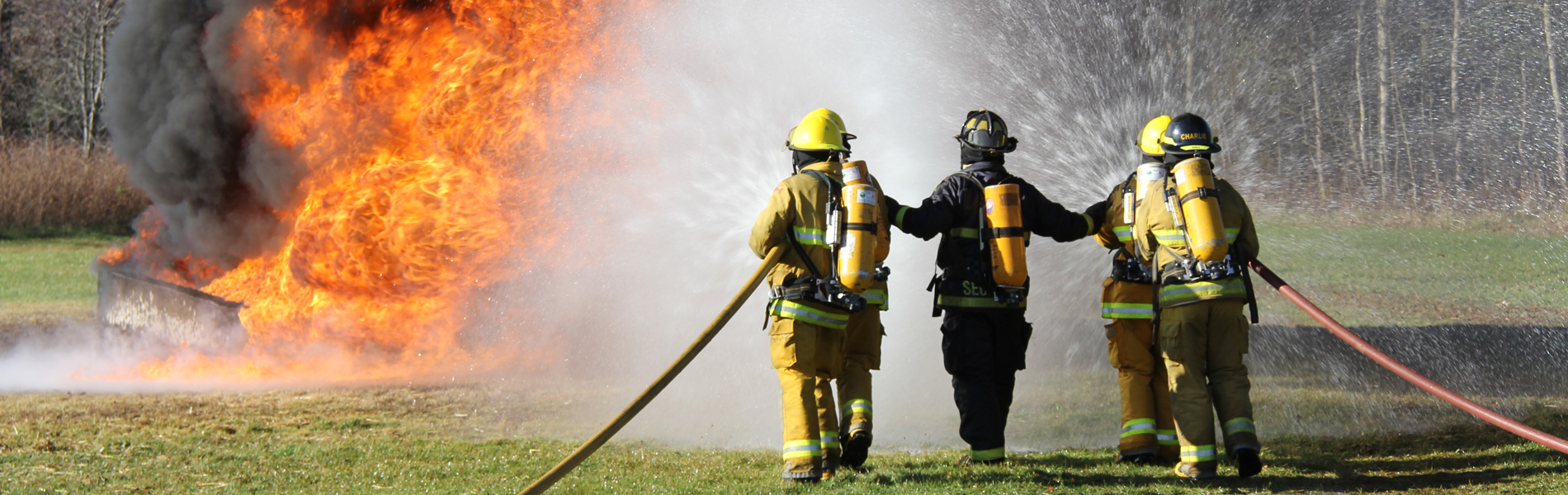
Firefighting is not just a job, it’s a lifestyle!
In the Professional Firefighter program, you will learn the fundamental firefighting skills needed to keep yourself, your colleagues, and the public safe in critical situations. Training at an off-campus site offers you firefighting experience in a controlled environment. You will learn about fire behaviour, motor vehicle extraction, medical first response, and communication in these training simulations.
Field training familiarizes students with equipment, including trucks, pumps, respirators, and hydraulic rescue tools such as Jaws of Life, to deal with fires, automotive accidents and public safety incidents. You will participate in eight weeks of on-the-job training in a career or a composite (career and volunteer firefighters) department of your choosing, with certain restrictions.
September 2026
Milton
Accepted students are required to complete their immunization form in their home province or country prior to program start. This helps avoid delays and ensures you're fully prepared for clinical placements, as some required vaccines can take time to complete.
If you're unable to complete your immunizations before arrival, you can reach out to the Holland College Health Clinic at 902-566-9392 or npclinic@hollandcollege.com.
This program has degree pathways, giving you the opportunity to receive credit for your Holland College diploma when you continue your education. For a complete list of agreements, visit the Degree Pathways page.
| Partner Institution | Credential | Details of Agreement |
|---|---|---|
| Columbia Southern University | Bachelor of Science in Criminal Justice Administration | Graduates receive 25 credits toward a Bachelor of Science in Criminal Justice Administration degree. |
Course Code:SAFE-1005
An overview of the Occupational Health and Safety Act of Prince Edward Island. Students examine the legislation, how PEI employees are protected while on the job and the responsibilities of employees and employers.
Credit Value:0
Course Code:BASICFF-10100
This course covers the theory portion of the sections required for a Fire Fighter I in the NFPA 1001, 2019 edition, Standard for Fire Fighter Professional Qualifications. Successful completion of this course is required to become certified as a Fire Fighter I.
Credit Value:7
Course Code:BASICFF-10101
This course covers the practical portion of the sections required for a Fire Fighter I in the NFPA 1001, 2019 edition, Standard for Fire Fighter Professional Qualifications. Successful completion of this course is required to become certified as a Fire Fighter I.
Credit Value:5
Course Code:BASICFF-10200
This course covers the theory portion of the sections required for a Fire Fighter II in the NFPA 1001, 2019 edition, Standard for Fire Fighter Professional Qualifications. Successful completion of this course is required to become certified as a Fire Fighter II.
Credit Value:2
Course Code:BASICFF-10201
This course covers the practical portion of the sections required for a Fire Fighter II in the NFPA 1001, 2019 edition, Standard for Fire Fighter Professional Qualifications. Successful completion of this course is required to become certified as a Fire Fighter II.
Credit Value:3
Course Code:BASICFF-10310
This course is designed to meet the theory requirements of NFPA 470 - Hazardous Materials Awareness / Weapons of Mass Destruction. Emergency Response Personnel are trained to meet the minimum job performance requirements to appropriately respond to incidents involving hazardous materials / weapons of mass destruction in order to protect the public, responders and the environment.
Credit Value:1
Course Code:BASICFF-10311
This course is designed to meet the practical requirements of NFPA 470 - Hazardous Materials Awareness / Weapons of Mass Destruction. Emergency Response Personnel are trained to meet the minimum job performance requirements to appropriately respond to incidents involving hazardous materials / weapons of mass destruction in order to protect the public, responders and the environment.
Credit Value:2
Course Code:BASICFF-10320
This course is designed to meet the theory requirements of NFPA 470 - Hazardous Materials Operations / Weapons of Mass Destruction. Emergency Response Personnel are trained to meet the minimum job performance requirements to appropriately respond to incidents involving hazardous materials / weapons of mass destruction in order to protect the public, responders and the environment.
Credit Value:3
Course Code:BASICFF-10321
This course is designed to meet the practical requirements of NFPA 470 - Hazardous Materials Operations. Emergency Response Personnel are trained to meet the job performance requirements to appropriately respond to incidents involving hazardous materials / weapons of mass destruction in order to protect the public, responders and the environment. Learn to effectively use personal protective equipment in cases of hazardous material releases, and how to implement control measures.
Credit Value:1
Course Code:BASICFF-10500
On-the-job training provides students with an opportunity to apply skills and knowledge acquired in the Professional Firefighter program to a relevant work environment. OJT participants are expected to assume, with appropriate supervision, the duties and responsibilities normally expected of an entry-level firefighter. Using their own observations and initiative, students are expected to acquire and apply new skills as may be expected of a new employee in their respective workplace setting.
Credit Value:6
Course Code:BASICFF-11000
This course is designed to prepare students for the firefighting profession and the various physical tests that are required. Students learn and are challenged to lead a healthy lifestyle by improving their fitness level and nutrition.
Credit Value:2
Course Code:NCPR-1002
Students complete Workplace Hazardous Materials Information System (WHMIS) training and certification.
Credit Value:0
Course Code:NCPR-1400
Pre-hospital care and CPR skills for professional first responders or those wanting to become first responders. This course teaches techniques for sustaining life, preventing further injuries, and caring for illnesses and injuries until the next level of medical personnel arrives. Includes CPR level HCP and AED. Successful participants will receive a 3-year certification in First Responder, CPR Level HCP, and AED.
Credit Value:0
Course Code:NCPR-1500
Introduction to ICS is intended for personnel assigned to an incident or event who have a minimum requirement for understanding ICS. Students learn about the ICS organization, basic terminology, and common responsibilities, and are provided with basic information about the Incident Command System to enable them to work in a support role at an incident or event, or to support an incident from an off-site location.
Credit Value:0
Course Code:NCPR-1505
ICS 200 focuses on smaller, less complex incidents and events and is an awareness-level course on the Incident Command System. The course builds on concepts learned in ICS 100, providing more detail on the features, principles, responsibilities and organizational structure of the system. It also provides the foundation for higher level ICS training.
Credit Value:0
Course Code:PROF-1050
The purpose of this course is to examine and practice ethical and professional behaviors to prepare students for making ethical choices during their time at the academy and in their professional public safety careers. Students are required to produce and follow a personal code of ethics, work as a team, and to exhibit behaviors and values that are consistent with the expectations of the profession and the public.
Credit Value:1
All Firefighting cadets are required to live in residence at the Atlantic Police Academy for the duration of their training, except when they are in on-the-job training. No additional residence application is required; accepted applicants will be assigned a room automatically after paying a tuition deposit.
Are you physically ready for this program? In this video, Coach Corey Arsenault tells you what to expect and how to prepare before you get here!
Upon successful completion of the program, graduates will be able to:
Graduates receive a certificate with the designation Firefighter Level I, Firefighter Level II, Haz-mat Awareness, and Haz-mat Operations, and can work internationally as professional, full-time firefighters and industrial firefighters.
This program obtained its accreditation from the International Fire Service Accreditation Congress (IFSAC) in 2006 and is maintains its accreditation in accordance with IFSAC guidelines. The Professional Firefighter program was established in accordance with the National Fire Protection Association Standard (NFPA1001) for fire service professional qualifications.
The program is also accredited by the Canadian Forces College Opportunities Program through the Association of Canadian Community Colleges (ACCC), and has an established partnership with the Prince Edward Island Firefighters Association.
NOTE: Obtain IFSAC logo from other site

This program provided exceptional instruction with knowledgeable and experienced instructors who truly care about their student's success. The paramilitary structure paired with the comprehensive training facilities sets this program ahead of others and has well-prepared me for the job.
Julia Arnason, Squad 27
Study Police Science at The Atlantic Police Academy and learn the academic and tactical skills required to work as a Police Officer in Canada.
The Primary Care Paramedicine program will prepare you to be an integral part of the health care team working in the field of pre-hospital care.