Environmental Applied Science Technology
Applied Sciences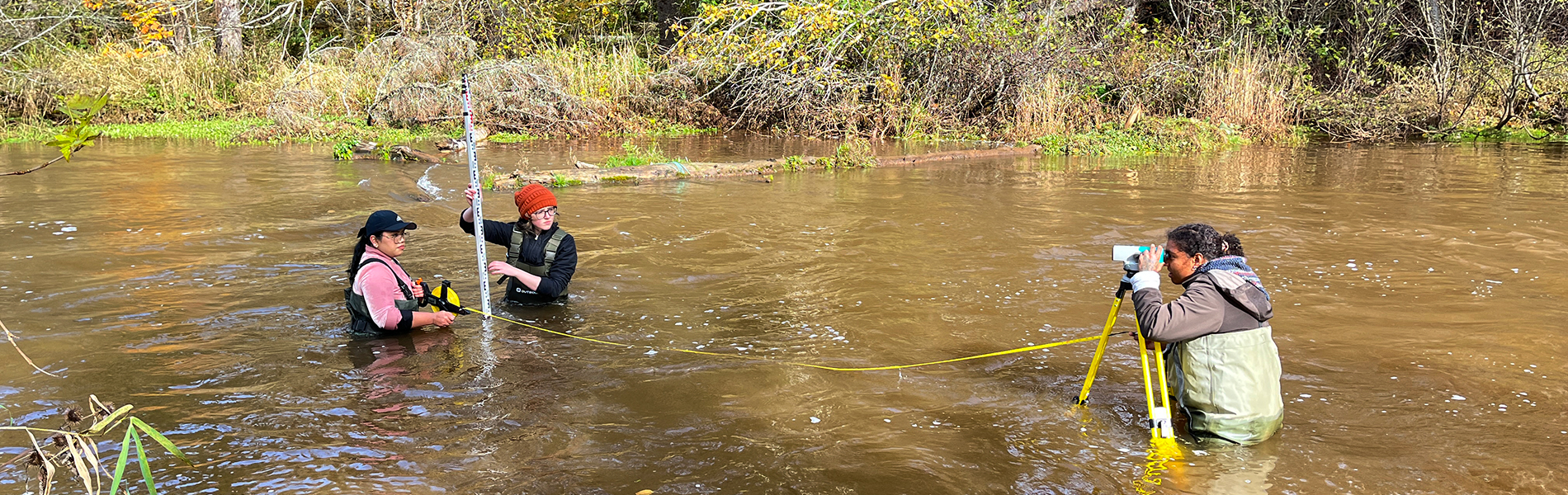
Our mission is to guide, educate and lead students to become stewards of the environment through hands on learning, scientific research, collaboration, and critical thinking.
This program teaches you scientific theory in classes such as environmental microbiology, soil science, air quality, environmental chemistry, environmental management, and site assessments. Learn about climate change, groundwater contamination and flow, impacts of pollution, ecosystem health, waste management, and environmental sustainability. Take your love of the environment outdoors to apply these theories while working and sampling in rivers, streams, and various facilities. Collect and analyze water, soil, and air samples and compare results from previous years to monitor environmental health.
This site is protected by reCAPTCHA and the Google Privacy Policy and Terms of Service apply.
Thank you for reaching out!
Your information has been submitted successfully. A member of our team will be in touch with you soon.
September 2027
Prince of Wales Campus
Program Length
2 Years
Credential
Diploma, Environmental Applied Science Technology
Canadian Tuition
International Tuition
Canadian Applicants
Accepting Applications
International Applicants with a Valid Study Permit
Accepting Applications
Other International Applicants
Accepting Applications
Notes:
Don’t have the courses you need to get into this program? Visit our Academic Upgrading section to learn how to upgrade high school credits or get your high school equivalency credential (CAEC).
This program has degree pathways, giving you the opportunity to receive credit for your Holland College diploma when you continue your education. For a complete list of agreements, visit the Degree Pathways page.
| Partner Institution | Credential | Details of Agreement |
|---|---|---|
| Cape Breton University | Bachelor of Health | Graduates receive two years of credit toward a Bachelor of Health (Public Health) degree. |
| Griffith University | Bachelor of Environmental Science | Graduates may complete a Bachelor of Environmental Science degree in one and a half years. |
| Lakeland College | Bachelor of Applied Science in Environmental Management | Graduates will receive admission to Year 3 of the Bachelor of Applied Science in Environmental Management program. |
| Royal Roads University | Bachelor of Science | Graduates receive two years of credit toward a Bachelor of Science degree, but require three additional university level courses in biology, biochemistry, or microbiology, as well as math (linear algebra or calculus) and English. |
| Royal Roads | Bachelor of Arts in Environmental Practice | Graduates receive up to two years of credit toward a Bachelor of Arts in Environmental Practice degree. |
| Saint Mary's University | Bachelor of Science | Graduates must meet SMU’s admission requirements and have obtained an overall average of 70 percent in their courses to be granted up to 60 hours in one of the university’s 120-credit hour science degree programs |
| University of New Brunswick - Fredericton | Bachelor of Science, Environmental & Natural Resources | Graduates receive up to 62 credits toward Bachelor of Science in Environmental and Natural Resources degree. |
| University of New Brunswick - Saint John | Bachelor of Applied Management | Graduates with a 70% average receive two years of credit toward a Bachelor of Applied Management degree. |
| University of Prince Edward Island | Bachelor of Environmental Studies | Graduates with a 70% average will receive 60 credit hours toward a Bachelor of Environmental Studies degree. |
SAFE-1005
An overview of the Occupational Health and Safety Act...
0
BIOL-1050
This course provides an introduction to environmental biology, including a practical introduction to the structure and function of living organisms. The effects of environmental conditions on biological life and the effects of biological life on the environment are emphasized with a focus on invertebrate life. The field and laboratory components provide hands-on experience in the collection, identification and assessment of the biodiversity and ecological health.
2.00
BIOL-1100
An introduction to applied microbiology including a practical and theoretical introduction to structure and function of micro-organisms. The diversity of the microbial world is examined by comparing bacterial, fungal, protozoan and viral organisms. The growth, reproduction and enumeration of micro-organisms are studied as well as the effects of environmental conditions on microbial growth. The laboratory component provides hands-on experience in the isolation, cultivation and enumeration of micro-organisms as well as in the preparation of microbiological media.
3.00
CHEM-1005
This chemistry course focuses on building core knowledge and skills required in the Environmental Science field. This course provides an examination of the core principles of chemistry, including the properties of elements, compounds and solutions. Other topics covered include inorganic and organic nomenclature, acids, bases, gas laws, and thermodynamics/kinetics as they relate to environmental chemistry. It includes an evaluation of the fate and behaviour of organic and inorganic compounds in the environment.
3.00
CHEM-1010
An introduction to the skills and knowledge required to work efficiently and effectively in a laboratory setting. Students are trained in basic laboratory safety and Hazardouz Materials Information System (HMIS) before being introduced to a variety of wet chemistry techniques used in an environmental laboratory. Finally, a review of the selection, calibration, use, and maintenance of laboratory analytical instrumentation is included. Quality assurance and quality control are introduced with respect to their use in laboratory activities and in data analysis and interpretation.
4.00
COMM-1110
The vital role that communication plays in the science field will be emphasized in this course. The importance of accurate recording of laboratory and field activities as well as the ability to communicate findings to both the scientific and general communities will be stressed.
3.00
COMP-1000
Students learn productivity software and explore digital environments with practical applications for various workplaces and educational institutions. The main areas of focus include word processing, spreadsheets, presentation software, email and other electronic communication tools, various digital environments, and industry-specific applications.
3.00
ENVR-1000
Introduction to the fundamental principles of ecology and environmental science. It emphasizes an ecosystem approach to studying the environment. The interactions between abiotic and biotic factors are examined to gain an understanding of how a dynamic balance is achieved in natural ecosystems. This course examines the effect of human intervention on ecosystems and biomes as well as the major trends in resource consumption and use. Students gain a better understanding of how the environment is altered by human action and why these actions may have significant effects on an ecosystem and its sustainability. This course is the essential starting point for Environmental Science students as it lays the groundwork and describes the interconnections between the various components of the program.
3.00
ENVR-1010
Examination of factors influencing ambient and indoor air quality. Course components include a review of types and sources of air pollution, sampling and measurement systems for gases, vapours, aerosols and particulates; environmental and occupational sampling strategies, principles of source (stack gas) sampling, and air pollution treatment and control systems. A brief review of indoor air quality (IAQ) sampling, control and mitigation is also included.
3.00
ENVR-2010
Exploration of the factors affecting the quality of water resources in the environment. The physical, chemical and biological properties of water are examined for various uses. In addition, the operation of water treatment facilities, including the distribution system, is reviewed. A significant component of the course is the development of field and laboratory skills, using standard methods for sampling and analysis of water samples.
5.00
ENVR-2025
A comprehensive study of surface water and groundwater resources and their inter-relationships. The course focuses on the principles of flow and measurement as well as water resources management. Topics include an overview of the hydrologic cycle and its component processes, flow measurement, the influence of precipitation events on surface water and groundwater, and the physics of water movement in both the saturated and unsaturated zones. Special topics addressed include sampling techniques, the installation of wells, watershed management, as well as a review of water quality and supply issues.
4.00
ENVR-2030
A comprehensive study of soil systems. Specifically, students are introduced to the fundamental physical, chemical and biological properties of soils. An important theme throughout the course is evaluating soil quality for agriculture and engineering applications.
5.00
ENVR-2040
Examination of the regulatory aspects of environmental protection in Canada, with a focus on Prince Edward Island. Students review the basics of law, including applicable federal and provincial environmental legislation and associated regulations and the key concept of due diligence, duty to consult, and overall legal environmental responsibilities.
3.00
ENVR-2050
This course explores contemporary waste management practices within local, national, and global contexts. Emphasizing sustainable approaches, it examines the role of the circular economy in waste reduction and resource recovery. Students will delve into the properties of waste, management hierarchies, and pertinent regulatory frameworks. Through detailed case studies, students will evaluate the effectiveness of diverse waste management strategies. Additionally, field trips to waste management facilities will offer practical, real-world insights into these concepts.
3.00
ENVR-2060
An introduction to the fundamental concepts of performing environmental site assessments. The basic procedures used to perform Phase I, II and III assessments are discussed. A review of the regulatory environment is provided. Case studies are used to highlight different approaches to performing environmental site assessments.
3.00
ENVR-2070
An introduction to the operation of municipal wastewater treatment systems, sewage lagoons and on-site treatment systems. Topics covered include preliminary, primary, and secondary treatment systems, and effluent disinfection and disposal. Practical aspects of system operation are emphasized including sampling and analysis of wastewater, process control and interpretation of results within the context of applicable federal and provincial regulations.
4.00
ENVR-2080
Students will establish and develop problem-solving skills in application to environmental management and planning to support the goal of sustainable development. Students explore existing conflicts between value systems and the practical implications for considering sustainability issues in a wide variety of applications. Students focus these skills on an environmentally sustainable land development project, ensuring consideration of the scientific, political, economic and ethical implications.
4.00
GEOG-1010
Use and practice mapping and navigation skills in the field. Students gather and translate data, prepare maps, and experience how a Global Positioning System (GPS) and Global Information System (GIS) are applied in occupational fields.
3.00
MATH-1200
This course in mathematics for applied science programs begins with an intensive overview of measurement, emphasizing both metric and imperial units, conversion of simple and derived units, proper treatment of significant digits, and techniques for handling measurement error. Following a review of algebra and Euclidean geometry (including many scientific calculator functions), the course will continue to apply mathematical skills to solve systems of two and three linear equations by means of graphic, algebraic, and determinant methods; derive and graph functions; and utilize factoring techniques to solve fractional and quadratic equations. The course will utilize trigonometric and vector analysis to solve practical problems involving angles in any quadrant, as well as right and oblique triangles. Finally, the relationship between exponents and radicals, and the relationship between exponential and logarithmic functions will be applied to biotic systems.
4.00
MATH-1300
Exploration of the essentials of statistical collection, analysis, and interpretation. Topics covered include the principles of statistical design, frequency distributions, descriptive statistics, measures of central tendency and dispersion, basic probability, standard normal distributions, linear regression and correlation, and a variety of statistical tests for goodness of fit, differences between means, and identification of outliers. Emphasis will be placed on the use of statistical software for data analysis.
2.00
NCPR-1001
A comprehensive two-day course offering standard first aid and cardiopulmonary resuscitation (CPR) skills from a certified trainer. As required by regulation, this course covers CPR and the management of other breathing, airway and circulation emergencies, as well as, the control of bleeding, treating shock, stabilizing fractures and dislocations, head and spine injuries, and more. Also, includes automated external defibrilators (AED). This certification expires in 3 years.
0.00
NCPR-1002
Students complete Workplace Hazardous Materials Information System (WHMIS) training and certification.
0.00
NCPR-1003
Students learn about asbestos containing materials in buildings, mould awareness and how moisture affects mould growth, lead containing materials in buildings, mercury and PCBS in buildings, radon.
0.00
NCPR-1005
Students are trained and certified at an awareness level to work in an environment where they may be exposed to asbestos containing materials. This certification does not include removing asbestos.
0.00
PRAC-2035
On-the-job training provides learners with an opportunity to apply skills and knowledge acquired in the Environmental Applied Science Technology program to a relevant work environment. OJT participants will be expected to assume, with appropriate supervision, the duties and responsibilities normally expected of an entry-level employee in a similar position. Using their own observations and initiative, learners will be expected to acquire and apply new skills as may be expected of a new employee in their respective workplace setting.
4.00
SAFE-1100
An introduction to the procedures, standards, legislation and programs used to maintain and improve the quality of industrial workplace environment from a health and safety perspective. These areas include: the recognition, evaluation and control of workplace hazards; industrial hygiene; awareness of technical standards, and worker health programs. A key component is a review of the methods of workplace health and safety compliance monitoring.
2.00
Upon successful completion of the program, graduates will be able to:
By graduation, you will be qualified to work as an environmental technician, or you may continue your education to earn a degree through a degree pathway.
The Environmental Applied Science Technology program has been accredited by the Environmental Careers Organization of Canada (ECO Canada) based on conformance with the National Accreditation Standard for Post-secondary Environmental Programs. The accreditation has been granted through the Canadian Environmental Accreditation Commission (CEAC), an independent body that oversees ECO Canada’s post-secondary accreditation program. This accreditation supports our program by providing customized labour market research and industry connections, and a curriculum framework that provides ongoing, continuous improvement. Accreditation supports the graduates of our program through access to mentorship, tools, and resources to follow throughout their career pathways.

I enjoyed every single aspect of this program. [The] second year has exceeded my expectations with the amazing organization of material and interactive class lectures. The courses this program offers are great for preparing us for the workforce. I’m happy to come to class every day, I enjoy the assignments and testing. I highly recommend this program to anyone interested in environmental work.
- Graduating Student Survey Respondent, Class of 2024
Develop extensive research and laboratory skills in the 2-year Bioscience Technology program.
Start your career as a Wildlife Technician! Learn to collect samples, conduct experiments, & prepare reports in the Wildlife Conservation Technology Program.