Wildlife Conservation Technology
Applied Sciences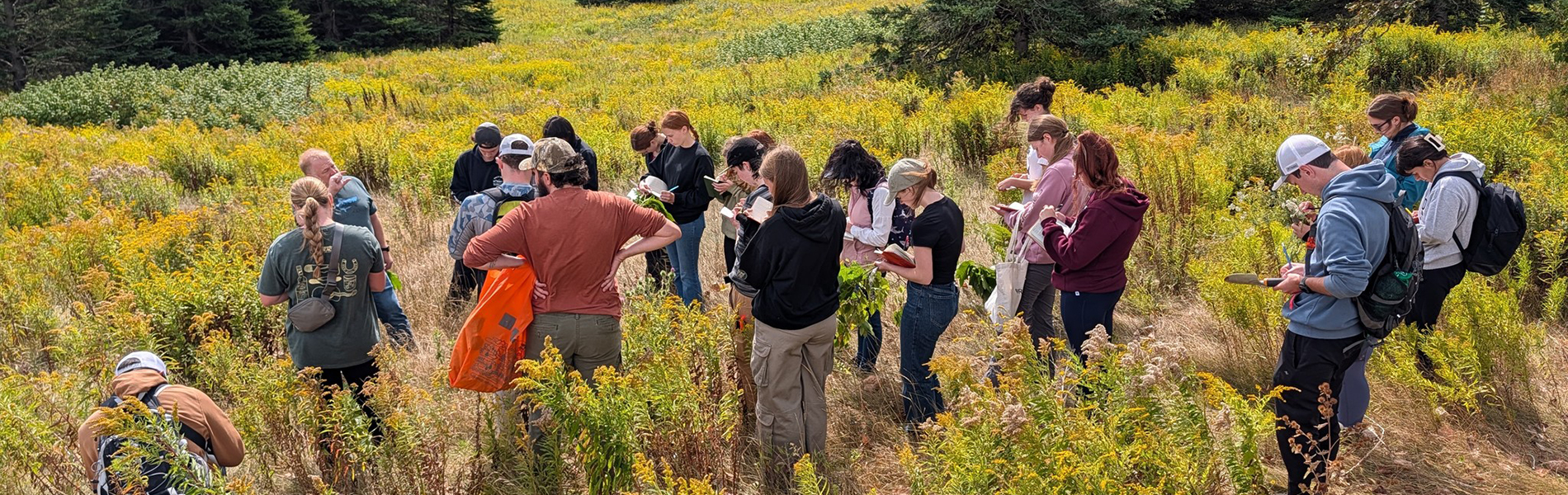
Wildlife Conservation Technology combines the great outdoors with classroom learning.
Learn about plant and animal ecology, environmental chemistry, map use and analysis, canoe safety, advanced wilderness and remote first aid, and wildlife management. You will spend many hours in field camps, where you will conduct habitat and night animal surveys, tour parks and wildlife rehabilitation centres, learn about wildlife and human interaction, and much more. You will use your new skills during 160 hours of on-the-job training. You will take part in songbird banding every year, contributing to the songbird population and migration research on a regional and global scale.
You may use this program as a stepping-stone to your Bachelor in Wildlife Conservation degree from UPEI.
This site is protected by reCAPTCHA and the Google Privacy Policy and Terms of Service apply.
Thank you for reaching out!
Your information has been submitted successfully. A member of our team will be in touch with you soon.
September 2027
Prince of Wales Campus
Program Length
2 Years
Credential
Diploma, Wildlife Conservation Technology
Canadian Tuition
International Tuition
Canadian Applicants
Accepting Applications
International Applicants with a Valid Study Permit
Accepting Applications
Other International Applicants
Accepting Applications
Notes:
Don’t have the courses you need to get into this program? Visit our Academic Upgrading section to learn how to upgrade high school credits or get your high school equivalency credential (CAEC).
This program has degree pathways, giving you the opportunity to receive credit for your Holland College diploma when you continue your education. For a complete list of agreements, visit the Degree Pathways page.
| Partner Institution | Credential | Details of Agreement |
|---|---|---|
| Lakeland College | Bachelor of Applied Science in Environmental Management | Graduates will enter Year 3 of a Bachelor of Applied Science in Environmental Management. |
| Royal Roads University | Bachelor of Science | Graduates receive two years of credit toward a Bachelor of Science degree, with three additional university level courses: chemistry, math (linear algebra or calculus), and English. |
| Royal Roads | Bachelor of Arts in Environmental Practice | Graduates receive up to two years of credit toward a Bachelor of Arts in Environmental Practice degree. |
| Saint Mary's University | Bachelor of Science | Graduates who meet SMU admission requirements and have obtained an overall average of 70% in their courses may be granted up to 45 credit hours in a 120-credit hour degree program. SMU requires that 50% of a student’s degree and 50% of a student’s major be completed at SMU. |
| University of New Brunswick - Fredericton | Bachelor of Science in Environmental and Natural Resources | Graduates receive up to 63 credits toward a Bachelor of Science in Environmental and Natural Resources. |
| University of New Brunswick - Saint John | Bachelor of Applied Management | Graduates with a 70% average receive two years of credit toward a Bachelor of Applied Management degree. |
| University of Prince Edward Island | Bachelor of Wildlife Conservation | Graduates receive 60 hours of credit toward a Bachelor of Wildlife Conservation degree. |
SAFE-1005
An overview of the Occupational Health and Safety Act...
0
BIOL-1200
A foundational course in ecology. Students study animal behaviour, habitats and niches, life histories, and conservation. Also, students explore the relationships among various organisms in ecosystems.
4.00
BIOL-1201
An examination of the parameters of population structure, identification of mammals, birds, amphibians and reptiles, and basic genetics. Also, students learn to make field identifications, conduct animal population surveys and assessments.
6.00
BIOL-1205
A survey course of common plants of the local plant communities including bog, dune, forest, roadsides and fields, ponds and saltmarshes. Students experience hands-on plant collection, identification and habitat assessment instruction in a variety of local habitats. Students prepare archival quality plant specimens and present them in the form of a plant collection.
4.00
BIOL-1206
Building on the skills and knowledge gained in Plant Ecology I students learn plant adaptations, plant families, plant anatomy, diseases and winter identification of plants.
3.00
BIOL-1220
A fundamental study of the ecology of freshwater rivers, streams and lakes. Subjects covered are watersheds, streams, lakes, lake types and water quality.
3.00
BIOL-2200
An introduction to the study of zoology and a survey of invertebrates with a focus on field and lab identification of invertebrates commonly encountered by wildlife technicians. This course includes the use and care of microscopes, and the collection and preservation of specimens.
3.00
BIOL-2201
A survey of vertebrates with a focus on their importance from a management perspective. Included in this course are specimen preparation, preservation and vertebrate anatomy and dissection.
3.00
CHEM-2000
Exploration of basic chemistry and chemical processes as they apply to nutrient cycling, soils, climate change, long range transport of atmospheric pollutants, waste management/nutrient enrichment, heavy metals in the environment, toxic organic chemicals/pesticides, and water pollution and purification. Knowledge gained will be applied to aspects of environmental monitoring.
3.00
COMM-1110
The vital role that communication plays in the science field will be emphasized in this course. The importance of accurate recording of laboratory and field activities as well as the ability to communicate findings to both the scientific and general communities will be stressed.
3.00
COMP-1000
Students learn productivity software and explore digital environments with practical applications for various workplaces and educational institutions. The main areas of focus include word processing, spreadsheets, presentation software, email and other electronic communication tools, various digital environments, and industry-specific applications.
3.00
GEOG-1000
Use and practice mapping and navigation skills in the field. Students gather and translate data, prepare maps, and experience how a Global Positioning System (GPS) and Global Information System (GIS) are applied in occupational fields.
3.00
MATH-1200
This course in mathematics for applied science programs begins with an intensive overview of measurement, emphasizing both metric and imperial units, conversion of simple and derived units, proper treatment of significant digits, and techniques for handling measurement error. Following a review of algebra and Euclidean geometry (including many scientific calculator functions), the course will continue to apply mathematical skills to solve systems of two and three linear equations by means of graphic, algebraic, and determinant methods; derive and graph functions; and utilize factoring techniques to solve fractional and quadratic equations. The course will utilize trigonometric and vector analysis to solve practical problems involving angles in any quadrant, as well as right and oblique triangles. Finally, the relationship between exponents and radicals, and the relationship between exponential and logarithmic functions will be applied to biotic systems.
4.00
MATH-1300
Exploration of the essentials of statistical collection, analysis, and interpretation. Topics covered include the principles of statistical design, frequency distributions, descriptive statistics, measures of central tendency and dispersion, basic probability, standard normal distributions, linear regression and correlation, and a variety of statistical tests for goodness of fit, differences between means, and identification of outliers. Emphasis will be placed on the use of statistical software for data analysis.
2.00
NCPR-1002
Students complete Workplace Hazardous Materials Information System (WHMIS) training and certification.
0.00
NCPR-1100
Students will be trained and certified in safe All-terrain vehicle (ATV) riding practices.
0.00
NCPR-1101
While dealing with the tools of the forestry trade, particularly chainsaw safety and the physical well being of the worker, the Lesson Plan also covers the mental well being of the worker by covering such areas as harassment and employee rights. The plan begins with intensive classroom instruction and is followed with practical one-on-one, hands-on instruction in the woodlot.
0.00
NCPR-1102
Students receive training in the responsibilities of a boat operator, the importance of ensuring all the right boating safety equipment in on board in good working order, how to safely sharewaterways with other vessels. Students will also learn how to get a boat, guests and themselves prepared before leaving the dock, how to prevent unsafe situations once underway, and what to do in the event of an emergency.
0.00
NCPR-1103
Students receive training and certification in Advanced Wilderness and Remote First Aid, ideal for those participating in wilderness or remote activities within hours or days of advanced medical care. This course will enable participants to have an appreciation for the realities of providing First Aid in a wilderness and remote environment. Emphasis will be on practical skills, decision making, and management of the outdoor environment. Basic First Aid and CPR are included.
0.00
NCPR-1104
Beginner tandem paddlers are introduced to how to paddle with a partner in calm sheltered waters.
0.00
NCPR-1105
Students are trained and certified in firearms safety: the evolution of firearms, major parts, types and actions; basic firearms safety practices; ammunition; operating firearm actions; safe handling and carry procedures; firing techniques and procedures; care of non-restricted firearms; responsibilities of the firearms owner/user; and safe storage, display, transportation and handling of non-restricted firearms.
0.00
NCPR-2100
Students are trained and certified in basic forest fire suppression techniques.
0.00
NCPR-2101
Students are trained and certified in aspects of hunting safety. This includes an online portion and a field day.
0.00
NCPR-2102
Students are trained and certified in backpack electrofishing. The training includes online study and on-site practical training. Topics include: what is electrofishing; why electrofish; electrofishing theory; impacts of electrofishing; electrofishing safety guidelines; field procedures and techniques; and recommended standard operating procedures.
0.00
NCPR-2104
Students are trained and certified in safe trapping practices.
0.00
PRAC-2045
On-the-job training provides the student with an opportunity to relate what they have learned in the Wildlife Conservation Technology program to a relevant work environment. Students assume, with appropriate supervision, the duties and responsibilities normally expected of an entry-level person in a similar position. Using their own observations and initiative, students are expected to acquire and apply new skills as may be expected of a new employee in their respective workplace setting.
4.00
WCTN-1100
Students experience camp life combined with field surveys, tours of parks and wildlife rehabilitation centers, evening and night animal surveys, Global Positioning Systems use, and habitat surveys. Students learn the skills necessary for bonding, living together, team building, work load balancing, survival, camping procedures, maintenance and use of camping equipment, and wildlife/human interaction.
2.00
WCTN-1110
Building on skills and knowledge of camp life combined with wildlife observations, taking particular note of seasonal differences and evening and night animal surveys. Students learn the skills necessary for bonding, living together, team building, work load balancing, survival, camping procedures, maintenance and use of camping equipment, and wildlife/human interaction.
2.00
WCTN-2005
An overview of the policies and legislation at the municipal, provincial and federal levels, governing natural resources: fish, wildlife, land and forestry. Students examine jurisdiction, authority, and power, the making of policies and laws, as well as, specific pieces of legislation in Prince Edward Island and Canada.
3.00
WCTN-2010
Students study many aspects of wildlife management. Subject areas to be examined include the capture and tracking of wildlife, assessment of wildlife habitat, and the evolution of wildlife conservation.
3.00
WCTN-2011
A comprehensive course on wildlife management issues and practices. Subject areas include: wildlife population survey techniques, socioeconomic surveys, consumptive and non-consumptive uses of wildlife, and habitat use by wildlife. Students assess an assigned area of habitat and create a comprehensive habitat management plan for the area.
3.00
WCTN-2020
Students learn saltwater species identification, harvesting methods, population assessment, and habitat management. In addition, students collect and preserve specimens, conduct surveys, and determine age for various species.
3.00
WCTN-2030
A comprehensive review of the forest industry and forest management. Subject areas examined include: commercial forestry, forestry for wildlife and recreational values, forest pests and diseases, forest harvesting and regeneration, silviculture and holistic forest use. Additionally, students learn about fire as a management tool, fire ecology and forest cruising techniques.
3.00
WCTN-2100
This course builds on skills developed during previous field camps. Students experience camp life combined with field surveys, Global Positioning Systems use, telemetry, immobilization, and habitat surveys. Students will learn the skills necessary for bonding, living together, team building, work load balancing, survival, camping procedures, maintenance and use of camping equipment, and wildlife/human interaction.
2.00
Upon successful completion of the program, graduates will be able to:
The Wildlife Conservation Technology program is accredited by the North American Wildlife Technology Association. All students graduating from this program will receive North America-wide recognition as a Wildlife Technician and will receive a certificate from the accrediting body upon graduation.
Please note: some occupations in this field require a Criminal Record Check.

"The program exceeded all my expectations! What I loved the most about it was all our outdoor practices and hands-on activities such as bird banding, habitat assessments, and field trips around PEI.
During the program, I completed several certifications like Chainsaw Training, Advanced Wilderness First Aid, and Field Assistant on Aquatic Biomonitoring. These courses are important for future employment opportunities, but are also great experiences."
- Carolina, Class of 2021