Bioscience Joint Degree
Applied Sciences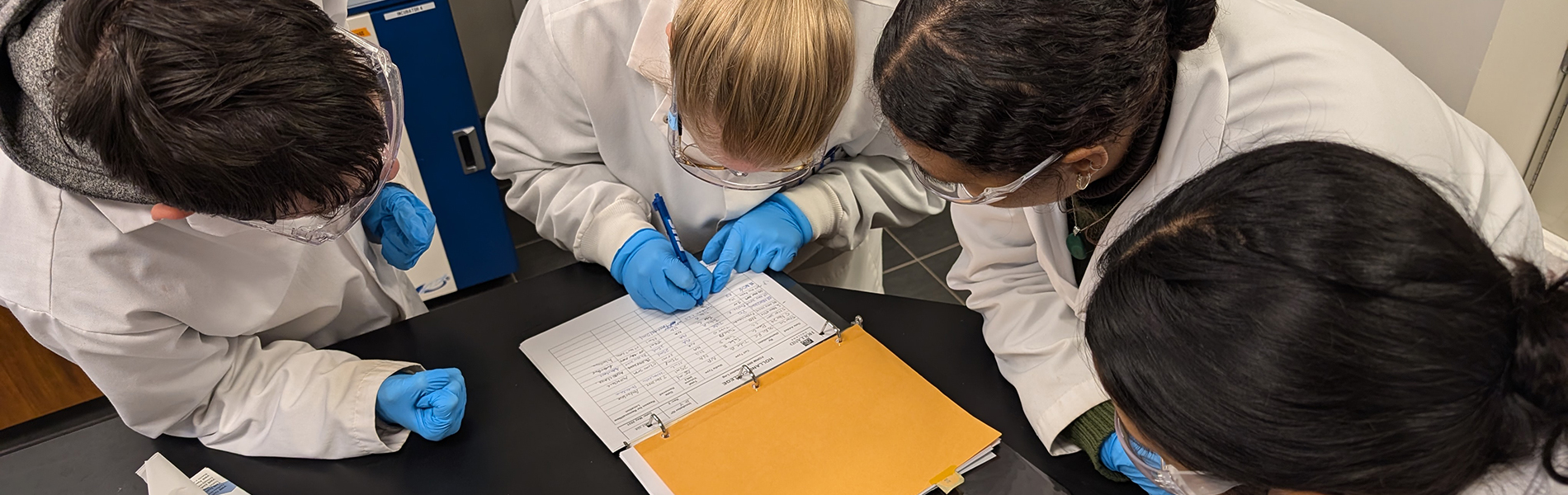
The Bachelor of Science in Biotechnology program is offered jointly by Holland College and the University of Prince Edward Island.
The program combines practical and applied courses from the Bioscience Technology program at Holland College with strong theoretical science courses from the University of Prince Edward Island. It is designed for students interested in obtaining rigorous and broad training in biotechnology and increasing their access to post-graduate opportunities such as Master's degree programs.
Recipient of the 2020 Gold Program Excellence Award from Colleges and Institutes Canada (CICan).
This site is protected by reCAPTCHA and the Google Privacy Policy and Terms of Service apply.
Thank you for reaching out!
Your information has been submitted successfully. A member of our team will be in touch with you soon.
September 2027
Prince of Wales Campus
Program Length
1 year plus 2 intersessions
Credential
Diploma, Bioscience Technology from Holland College, Bachelor of Science, Biotechnology from UPEI upon completion of final year
Canadian Tuition
International Tuition
Canadian Applicants
Accepting Applications
International Applicants with a Valid Study Permit
Accepting Applications
Other International Applicants
Accepting Applications
SAFE-1005
An overview of the Occupational Health and Safety Act...
0
BIOL-1213
This course focuses on laboratory methods used in the field of Biotechnology. Students will extract, purify, and identify molecules from natural sources. The course will provide instruction on basic laboratory techniques such as; measurement, pipette use, pH measurement and adjustment, solution preparation, casting and running agarose and acrylamide gels, gel imaging, and spectrophotometry. Techniques used will include bacterial culturing and media preparation, DNA purification, chemical extraction of pigments, thin layer and liquid chromatography, gel electrophoresis, and immunological techniques. This course is suitable for any students wishing to develop their lab skills and is a required course for those students in the Bioscience Technology Degree.
5.00
BIOL-1300
A study of the organization, classification and structure of bacteria and other microorganisms. Students perform the basic techniques involved in observation, cultivation and identification of selected microorganisms.
6.00
BIOL-1320
Examination of the chemical composition and structural organization of DNA, and the process (and regulation) of gene expression are addressed. Students isolate DNA from various sources and perform PCR based techniques to amplify and identify DNA samples.
3.00
BIOL-2300
Establish and maintain eukaryotic cell lines, following special requirements. Students become competent in all aspects of cell culturing.
2.00
BIOL-2310
Perfect techniques to introduce foreign genes, regulate their expression, and identify and purify the resulting protein product using both prokaryotic and eukaryotic host systems. Students identify the appropriate host and vector combinations, as well as the advantages and limitations of various host systems.
4.00
BIOS-1000
Follow good laboratory practices (GLP) while working with potentially harmful equipment and reagents. Learn basic scientific principles, and how to apply them in a laboratory setting.
3.00
BIOS-1100
Overview of the principal means of identification and classification of members of the plant kingdom. Plant structure and the biochemistry of photosynthesis are covered. Plant tissue and cell types are studied and students culture, maintain and propagate plants in vitro.
2.00
BIOS-2000
Conventional analytical methods such as gas chromatography and liquid chromatography will be compared to immunologically based methods and biosensors for qualitative and quantitative analysis of biological molecules. The sample preparation necessary for each type of analysis as well as the sensors used will be explored.
4.00
BIOS-2010
Students explore the ethical issues surrounding bioscience technology and learn to develop and articulate ethical debates. Students become familiar with various laboratory and manufacturing certification programs and how to comply with them.
3.00
BIOS-2110
Examination of industrially significant biotechnologies. Batch, continuous flow and fixed media reactor designs, downstream processing and refining of biological compounds are explored. Students participate in the entire production process, assessing how the critical steps of capture, purification and final polishing of biomolecules are achieved in production scale operations. Study of the equipment, materials and practices involved in commercial scale operations that use or produce biological elements. Material transport, scaling of unit operations, clean room practices and material properties will be explored. This course includes site visits to industrial production facilities.
4.00
BIOS-2300
Preparation for conducting research projects. Students conduct a literature review and develop a project proposal in preparation for a research project.
1.00
BIOS-2310
Students conduct an individual research project, based on research proposal developed in Research Preparation Bioscience Technology. The project entails designing and conducting the necessary research, compiling and reporting findings.
6.00
CHEM-1000
A survey of general chemistry, starting with the properties of the basic elements and their chemical reactions and progressing to the behaviour of organic compounds. Students study acid/base chemistry, chemical equilibrium and reductive/oxidative reactions.
4.00
CHEM-1300
An examination of the structure and role of lipids, fatty acids, carbohydrates, amino acids, and proteins. Mechanisms by which organic molecules react will be studied. An emphasis on the role of functional groups in organic reactions and enzyme kinetics is made. The laboratory portion focuses on enzyme isolation and related enzyme kinetics.
3.00
CHEM-2300
Recognizing the sources and methods of isolation and purification of molecules of pharmacological and industrial interest, students will isolate and test the biological activity of compounds from various sources. The production, purification and characterization of proteins will be emphasized, as will be the use of bioinformatic tools and databases to further understand genetic and protein sequences.
4.00
COMM-1110
The vital role that communication plays in the science field will be emphasized in this course. The importance of accurate recording of laboratory and field activities as well as the ability to communicate findings to both the scientific and general communities will be stressed.
3.00
COMP-1000
Students learn productivity software and explore digital environments with practical applications for various workplaces and educational institutions. The main areas of focus include word processing, spreadsheets, presentation software, email and other electronic communication tools, various digital environments, and industry-specific applications.
3.00
MATH-1200
This course in mathematics for applied science programs begins with an intensive overview of measurement, emphasizing both metric and imperial units, conversion of simple and derived units, proper treatment of significant digits, and techniques for handling measurement error. Following a review of algebra and Euclidean geometry (including many scientific calculator functions), the course will continue to apply mathematical skills to solve systems of two and three linear equations by means of graphic, algebraic, and determinant methods; derive and graph functions; and utilize factoring techniques to solve fractional and quadratic equations. The course will utilize trigonometric and vector analysis to solve practical problems involving angles in any quadrant, as well as right and oblique triangles. Finally, the relationship between exponents and radicals, and the relationship between exponential and logarithmic functions will be applied to biotic systems.
4.00
MATH-1300
Exploration of the essentials of statistical collection, analysis, and interpretation. Topics covered include the principles of statistical design, frequency distributions, descriptive statistics, measures of central tendency and dispersion, basic probability, standard normal distributions, linear regression and correlation, and a variety of statistical tests for goodness of fit, differences between means, and identification of outliers. Emphasis will be placed on the use of statistical software for data analysis.
2.00
MATH-2000
An introduction to the theory and methods of differential and integral calculus. Topics covered include the concepts of continuity, limits, and the derivative as an instantaneous rate of change. Methods of determining derivatives will cover both algebraic and transcendental functions. Practical applications will emphasize maximum/minimum problems. Topics in integration will include both definite and indefinite integrals.
2.00
NCPR-1002
Students complete Workplace Hazardous Materials Information System (WHMIS) training and certification.
0.00
NCPR-1020
Students complete Canadian Council on Animal Care (CCAC) certification training through UPEI.
0.00
PRAC-2400
Students apply and improve skills acquired in the Bioscience Technology program in a work setting. They integrate themselves into a laboratory or industrial production environment that utilizes bioscience technologies. Students are exposed to the professional standards, routines and demands of an organization and are expected to add value through the application of their skills and abilities.
6.00
Upon successful completion of the program, graduates will be able to:
The Bioscience Technology program is a TAC (Technology Accreditation Canada) nationally accredited program at the technologist level. National program accreditation involves an independent team of certified professionals performing an extensive audit, which provides graduates and employers confidence the program meets the educational standards of Canada’s engineering technology and applied science profession. Graduating from a nationally accredited program creates an expedited path to becoming a certified professional with provincial certifying bodies in Canada.
UPEI Students may qualify for the joint degree program if they have completed the pre-requisite courses identified in the Admission Requirements above. If accepted, students will complete one intersession course at Holland College in the spring, before beginning their third year of study at Holland College in the Fall. After completing their year at Holland College, students receive a diploma in Bioscience Technology. Students return to UPEI for their fourth year of the BSc program to complete their Bachelor of Science, Biotechnology Degree.
While at Holland College, students receive a combination of lab-based instruction and on-the-job training and complete an independent research project on a topic of their choice. Students learn practical skills, including natural product extraction, fermentation, and bacterial and animal cell culture techniques. The Bioscience Technology program at Holland College is closely associated with the bioscience industry on PEI and in the other Maritime Provinces. This relationship provides students access to amazing on-the-job training and research opportunities.

"The skills I gained at Holland College were instrumental in my journey to becoming valedictorian. The program provided invaluable hands-on experience. Moreover, I learned how to work effectively as part of a team, a skill that's essential in our biotech field. The combination of academic knowledge from UPEI and practical experience from Holland College has made me a well-rounded professional, ready to tackle the challenges in the biotechnology industry."
Ellis, class of 2023
Develop extensive research and laboratory skills in the 2-year Bioscience Technology program.
If you already have a science degree, this one-year post-graduate certificate program prepares you to work in the bioscience sector or pursue a master's degree.
Learn scientific theory and data collection techniques to conduct environmental assessments of soil, air, and water.