Power Engineering
Power Engineers are licensed by provincial and territorial governments to operate and maintain facilities located in power and heating generation plants, electrical power utilities, manufacturing plants, hospitals, universities, government buildings, and commercial businesses.
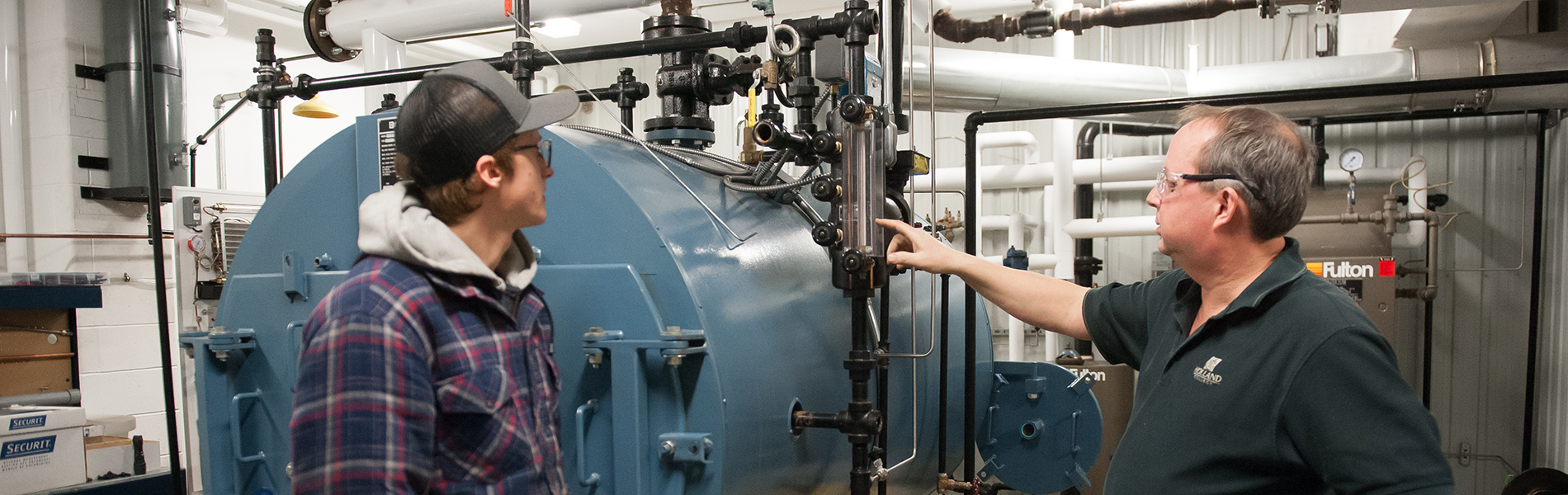
Roles & Responsibilities
Power Engineers operate and maintain reactors, turbines, boilers, generators, stationary engines, and auxiliary equipment to generate electrical power, process steam, and provide heat, light, refrigeration and other utility services for commercial, industrial, and institutional buildings and other work sites. Other responsibilities include monitoring and operating switchboards and related equipment to control electrical power distribution in transmission networks.
Currently, Power Engineers are provincially mandated under the Power Engineering Act and Regulations to be present within a facility when the boiler(s) and refrigeration system(s) have reached a specific kilowatt rating. There are currently over 200 people with valid Power Engineering licenses in Prince Edward Island who are actively employed.
There are four classes of licenses that range from 4th Class (entry-level) to 1st Class. Power engineers who obtain one of these licenses can move to the next level after acquiring work experience and passing the required Provincial exam.
Flexible Training
& Upgrading
Part-Time Flexible Delivery - 4th Class Power Engineering Program
This program is designed for candidates who are already working in the power engineering field with other responsibilities. Employment in a relevant industry is a prerequisite for this part-time study method.
The program must be completed within three years under the supervision of the candidate’s employer.
Upon successful completion of the program, students write the PEI Power Engineering Examination to qualify as a licensed power engineer.
Part Time Flexible Delivery - 4th Class Power Engineering courses:
- Preparatory Math Topic
- Applied Mechanics and Thermodynamics
- Introduction to Boiler and Boiler Systems
- Electrotechnology & Instrumentation and Controls
- Material Science and the Environment
- Jurisdictional Legislation Plant Safety and Industrial Communications
- Lubrication Pumps and Compressors and Prime Movers
- Boiler Safety Devices Operations Mng. and Water Treatment
- Refrigeration Systems
- Heating Cooling and HVAC Systems
- Industrial Plants, Plant Maintenance and Auxiliary Systems
3rd Class Power Engineer Uprading Courses
Course: 3-A-1
Course Title: 1st Paper 3rd Class Power Engineering
Tuition: $1,460
Prepares and qualifies the student to challenge the certification examination 3A1 as outlined in the 3rd Class Power Engineering Syllabus issued by the Standardization of Power Engineer Examination Committee (SOPEEC) of Canada. Studies cover the disciplines required for interpretation and completion of engineering calculations and related theory in the Applied Mathematics, Applied Mechanics, Thermodynamics, and Applied Sciences.
Course: 3-A-2
Course Title: 2nd Paper 3rd Class Power Engineering
Tuition: $1,460
Prepares and qualifies the student to challenge the certification examination 3A2 as outlined in the 3rd Class Power Engineering Syllabus issued by the Standardization of Power Engineer Examination Committee (SOPEEC) of Canada. Studies cover the disciplines of Industrial Legislation and Codes, Code Calculations (ASME Section 1), Fuels and Combustion, Piping, Electrotechnology, Electrical Calculations, Controls and Instrumentation, and Industrial Safety and Fire Protection.
Course: 3-B-1
Course Title: 3rd Paper 3rd Class Power Engineering
Tuition: $1,460
Prepares and qualifies the student to challenge the certification examination 3B1 as outlined in the 3rd Class Power Engineering Syllabus issued by the Standardization of Power Engineer Examination Committee (SOPEEC) of Canada. Studies cover the disciplines of Boiler Classification and Construction, Boiler Operation and Maintenance, Boiler Control Systems, Boiler Feedwater Treatment, Pump Classification and Construction, Pump Operation and Maintenance, Welding Procedures and Inspection, Pressure Vessel Design, Construction, Operation and Repair.
Course: 3-B-2
Course Title: 4th Paper 3rd Class Power Engineering
Tuition: $1,460
Prepares and qualifies the student to challenge the certification examination 3B2 as outlined in the 3rd Class Power Engineering Syllabus issued by the Standardization of Power Engineer Examination Committee (SOPEEC) of Canada. Studies cover the disciplines of Steam Turbine Construction and Operation, Gas Turbine Construction and Operation, Internal Combustion Engine Construction and Operation, Cogeneration Systems, Compressor Theory, Classification, Construction, Operation, and Maintenance, Refrigeration Theory, Classification, Construction, Operation, and Maintenance, Special Industrial Equipment and Processes, Wastewater Treatment, Plant Maintenance and Administration.