Sustainable Business Leadership
Business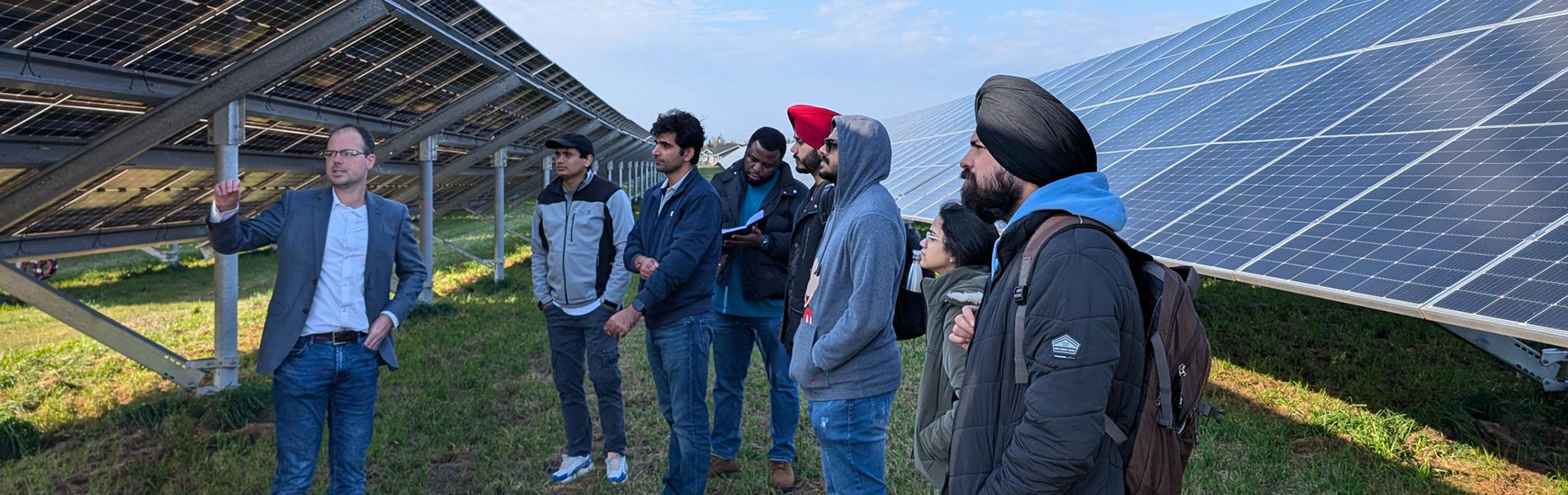
The post-graduate certificate in Sustainable Business Leadership is your gateway to the rapidly growing field of sustainability leadership and climate action.
The program has been designed to equip you with the knowledge, skills, and hands-on experience needed to lead organizations towards more sustainable operations and deploy clean tech solutions.
The program's comprehensive curriculum and variety of delivery methods will enable students to expand on conventional business success metrics to include a triple bottom line approach that enables them to measure and improve an organization’s contributions to planetary health, social well-being and a just economy.
This site is protected by reCAPTCHA and the Google Privacy Policy and Terms of Service apply.
Thank you for reaching out!
Your information has been submitted successfully. A member of our team will be in touch with you soon.
September 2027
Cleantech Academy
Program Length
1 Year
Credential
Post-Graduate Certificate, Sustainable Business Leadership
Canadian Tuition
International Tuition
Canadian Applicants
Accepting Applications
International Applicants with a Valid Study Permit
Accepting Applications
Other International Applicants
Accepting Applications
SAFE-1005
An overview of the Occupational Health and Safety Act...
0
PRAC-3305
On-the-job training provides students with an opportunity to apply skills and knowledge acquired in the Sustainable Business Leadership post-graduate program to a relevant work environment. OJT participants are expected to assume, with appropriate supervision, the duties and responsibilities normally expected of an entry-level employee in a similar position. Using their own observations and initiative, students are expected to acquire and apply new skills as may be expected of a new employee in their respective workplace setting.
6.00
STBL-3100
An introduction to data analysis and analytics for sustainability professionals. Organizations use data to gain insights that lead to fact-based management, further driving decisions and actions. The interpretation of data has become an essential skill for business managers facing a high volume, variety, and velocity of data. Students explore the three major areas of business analytics: reporting, visualization, and prediction. Students explore IoT (Internet of Things) and Big Data as it relates to sustainability.
3.00
STBL-3105
Students gain the basic energy literacy required to participate accurately and responsibly in policy discussion, personal and community decisions, and ventures in sustainable energy. The current realities of the electrical grid and the function of the electrical utility are analyzed within a context of energy alternatives. Multiple energy sources and storage options for the energy transition are explored.
3.00
STBL-3110
Research emerging local and global cleantech and sustainability businesses, products and services and investigate their feasibility through market and financial analysis. The components of a marketing plan are explored, while considering consumer behaviour and sustainability principles such as full cost pricing, life cycle analysis, and social equity. Students deliver marketing communications and apply entrepreneurial finance and accounting strategies to determine the viability of cleantech and sustainability business projects.
3.00
STBL-3115
Sustainable Development Goals (SDGs) are introduced alongside supporting frameworks that guide business to identify economic, social, and environmental opportunities for long-term value creation. Students apply systems thinking to identify key environmental solutions and economic tools with an eye to equity and justice from the local to global level. Business models that embed sustainability goals at the core of organizational strategy and across the functional areas of business are explored within the context of emerging economic models that address social and planetary well-being.
4.00
STBL-3120
Explore environmental science and the ways humans interact with the natural world, which contribute to our present-day environmental challenges, including climate change, and biodiversity loss. Students apply critical and systems thinking to explore more sustainable solutions, to an increasingly complex and inter-related set of environmental issues.
3.00
STBL-3125
Through case studies, field work, and independent research, students acquire the language, framework, and tools necessary to create a corporate action plan for sustainable operations in the areas of energy, waste, water, and greenhouse gas emissions, and apply the basics of GHG accounting. Students collect data, research industry best practices, regulations, and legislation, to make a business case for improved operational efficiency following a project management process.
4.00
STBL-3200
Sustainable business model tools are applied to social enterprise and cleantech solution ideas. The integration of international and national regulatory policies that influence business practices are emphasized. Students analyze how these policies shape the deployment and impact of innovative cleantech solutions, ensuring compliance and alignment with sustainability goals. Students develop the skills needed to navigate the regulatory landscape and analyze risk, while driving impactful, sustainable innovation.
4.00
STBL-3205
Expanding on foundational energy systems knowledge from Energy Fundamentals and Transitions, students evaluate methods to determine a community's energy demands, energy sources, advantages, limitations, and potential for integrating new, or scaling pre-existing, infrastructure. Students apply participatory methods for the creation of a community vision for alternative energy futures, and strategies to communicate a community energy plan.
3.00
STBL-3210
Explore the transformational change that is occurring to embed environmental, social, and governance (ESG) in organizational strategy and reporting. Become equipped with leading theories, various reporting standards (ISO, SBTI, GHG Protocol, TCFD AND CSRD) and tools to help organizations make this shift. Students deliver stakeholder engagement, and identify equity, diversity and inclusion practices and the role Canadian businesses play in rebuilding relationships with Indigenous Peoples. Students develop necessary skills to prepare comprehensive reports that meet organizational goals, regulatory requirements, and stakeholder expectations while supporting transparent, data-driven decision-making for sustainable practices.
3.00
STBL-3215
Using industry best practices, proven frameworks, and leading research, students work with an organization to analyze, design, and present an implementation plan for embedding a culture of sustainability through employee or community engagement. Insights on the psychology of sustainable behaviour are applied to an organization's current situation. Analyze data to develop a business case for engagement and to create and present an engagement plan that will foster an effective culture of sustainability.
3.00
STBL-3220
Develop self-awareness and leadership skills needed to become a sustainability leader. Through an examination of industry leaders' principles, values, and best practices across various sectors, students gain insights into creating and deploying cleantech and sustainability solutions. The performance and practices of successful business and environmental leaders are evaluated. Students apply acquired knowledge and skills, and gain experience leading teams.
3.00
STBL-3225
Building on skills acquired in Sustainable Operations I, students complete a corporate sustainability action plan. Baseline assessments for key sustainability metrics, including areas of travel and transportation, supply chain, and buildings and facilities are developed. Students facilitate organizations to successfully integrate sustainability solutions and incorporate continuous improvement, by divising action plans, creating organizational policy, and exploring tools for effective integration.
4.00
All students enrolled in the Sustainable Business Leadership program at Holland College must ‘bring your own device’ (BYOD). Enrollment in this program requires you to own a laptop computer for your studies.
Device: Laptop
By exploring topics such as foundational environmental science, emerging energy systems, business plans development, data analytics and strategies to lead through positive change, the program will provide you with the knowledge, skills, and hands-on experience to lead organizations toward more sustainable operations.
From setting, tracking, and reporting on sustainability metrics to collaborating with multiple stakeholders and rights-holders on innovative projects, to managing organizational change and communicating that change, Sustainable Business Leadership graduates will acquire the skill set needed to drive solutions within organizations and businesses that address current climate change and sustainability challenges.
Course content, projects and experiential learning opportunities provide students with a window into multiple sectors especially relevant to the Atlantic region, such as agriculture, fisheries, aquaculture, transportation, buildings, industry, and waste, with a special focus on clean technology.
This program is funded through the PEI Cleantech Academy, a joint initiative of Holland College, the University of Prince Edward Island, and the Province of PEI.