Industrial Electrical Technology
Industrial Technology and Trades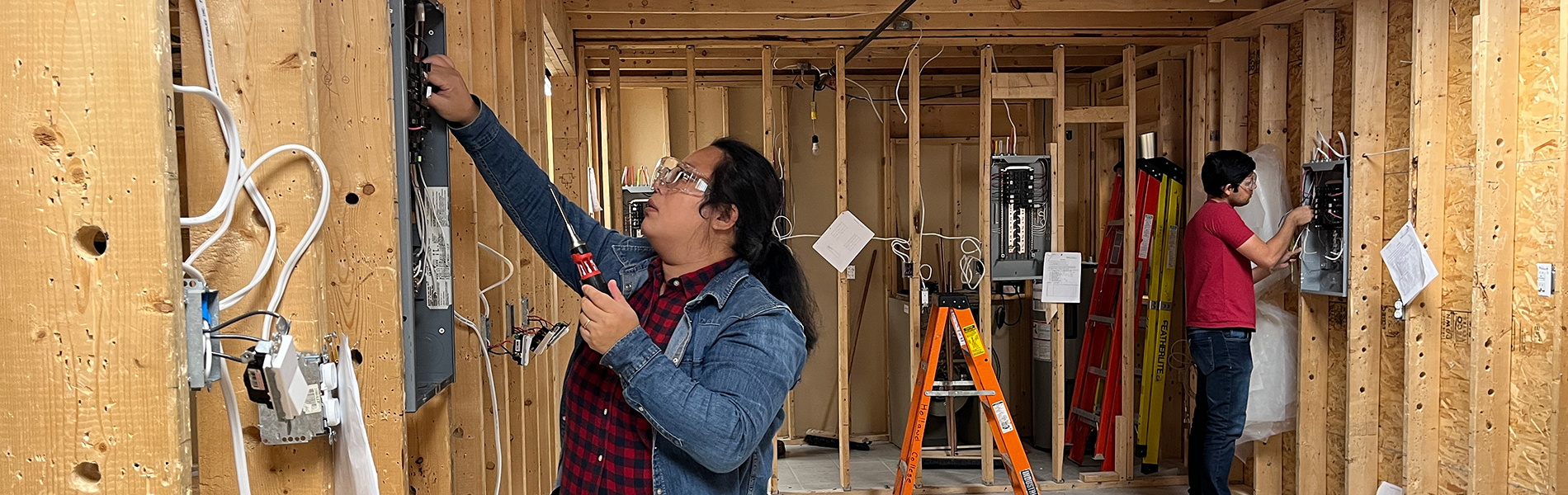
Learn how to plan, install, test, inspect, troubleshoot, and service all types of industrial electrical equipment.
You will take courses in the essentials of electricity, wiring and circuits, as well as advanced courses in automation and motion control, programmable logic controls, industrial communication systems, and computer-aided design.
The Industrial Electrical Technology program also prepares you for a variety of roles by teaching you construction and residential wiring methods. What you learn in class, you’ll demonstrate and test in a variety of on-site electrical lab areas, giving you hands-on training and exposure to real-life working conditions to prepare you for a career as an industrial electrician.
This site is protected by reCAPTCHA and the Google Privacy Policy and Terms of Service apply.
Thank you for reaching out!
Your information has been submitted successfully. A member of our team will be in touch with you soon.
September 2027
Summerside Waterfront Campus
Program Length
2 Years
Credential
Diploma, Industrial Electrical Technology
Canadian Tuition
International Tuition
Canadian Applicants
Accepting Applications
International Applicants with a Valid Study Permit
Accepting Applications
Other International Applicants
Accepting Applications
Don’t have the courses you need to get into this program? Visit our Academic Upgrading section to learn how to upgrade high school credits or get your high school equivalency credential (CAEC).
This program has degree pathways, giving you the opportunity to receive credit for your Holland College diploma when you continue your education. For a complete list of agreements, visit the Degree Pathways page.
| Partner Institution | Credential | Details of Agreement |
|---|---|---|
| University of New Brunswick - Saint John | Bachelor of Applied Management | Graduates with a 70% average receive two years of credit toward a Bachelor of Applied Management degree. |
SAFE-1005
An overview of the Occupational Health and Safety Act...
0
ATMN-2100
In this course students learn the knowledge and skills necessary to understand what a Programmable Logic Control (PLC) is, some of what it can do, and how to perform basic programming and troubleshooting.
1.00
ATMN-2110
This course builds on the foundation set in Programmable Logic Controls I, allowing students to expand their knowledge of programmable controllers and programming. Students learn the graphical programming languages Function Block Diagram (FBD) and Sequential Function Chart (SFC) and construct programs using subroutines.
2.00
ATMN-2120
Instrumentation (process control) and motion (servo) control are two branches of control engineering that use industrial automation to produce a product or control a process. Students learn about the components, circuits, instruments, and control techniques used in these two branches of industrial automation. Theory is reinforced through lab activities and projects.
4.00
ATMN-2130
This course provides students with an overview of the industrial communication networks used today in many industrial plants and factories. Students learn about various hardware components, cabling types and network protocols. Using the Industrial Ethernet protocol, students develop software programs to communicate between Programmable Logic Controllers (PLCs), Human Machine Interfaces (HMIs), and Variable Frequency Drives (VFDs).
2.00
ATMN-2150
In this course students learn the practical skills required to perform the task of building an industrial control panel, complete with a PLC controller (programmable logic controller) and all associated inputs/outputs required for a complete turn-key operation. Students are responsible for ensuring that the control panel meets all applicable code requirements for the wiring methods used. Students also input their own PLC program to make the control sequence operate as per the specifications of the project.
2.00
BLPR-1010
The ability to read and understand blueprints is essential in the construction field, as blueprints are used to design, plan, estimate and build projects. This course introduces students to blueprint reading and sketching, with a focus on engineered drawings for residential and commercial types of structures.
2.00
CADD-1015
This course is an introduction to basic terminology, concepts and functions of Computer-Aided Design / Manufacturing (CAD/CAM) software. Students acquire the skills and knowledge to produce and modify technical drawings, set up and manage an electronic filing system, and specify hardware and peripheral equipment required to generate drawings. Students are also introduced to 3D modeling techniques and processes used to produce manufactured parts.
2.00
CADD-2015
This course focusses on the application of CAD software and the reproduction of specific use drawings for other courses.
2.00
COMM-1005
This course is designed to allow students to develop preparatory skills for securing and retaining employment including; workplace communication, time management, critical thinking and problem-solving, and customer service. Upon successful completion of this course students are able to use oral communications techniques, and create a variety of written documents and reports used in the workplace. Methods and strategies for job search, preparation and retention are also incorporated.
3.00
COMM-2005
This course combines essential oral and written communication skills needed for transitioning from school to the workplace. It covers formal technical writing, including business correspondence, informal and formal report writing, proper citation techniques, and report formatting. Additionally, it focuses on developing oral presentation skills for technical content, utilizing technology to enhance presentations.
2.00
COMP-1000
Students learn productivity software and explore digital environments with practical applications for various workplaces and educational institutions. The main areas of focus include word processing, spreadsheets, presentation software, email and other electronic communication tools, various digital environments, and industry-specific applications.
3.00
ELEC-1001
Students learn safe working practices and measures to ensure both personal and public safety as it pertains to the electrical trade. Students also learn about the Canadian Electrical Code (CEC), how to utilize this standard, and how it applies to electrical installations that they will encounter in the program, and throughout their careers.
3.00
ELEC-1015
Study of electricity, passive direct current (DC) circuits, and passive alternating current (AC) circuits. Learners analyze DC and AC circuits; select and test passive components; measure electrical quantities using appropriate test equipment. Construction and troubleshooting techniques for circuits are introduced.
5.00
ELEC-1035
Students learn the wiring methods and practical skills required for both residential and commercial / industrial installations ensuring compliance with the Canadian Electrical Code (CEC). The course focusses on the proper selection and installation of wiring, conduit, tubing and cables and the wiring methods employed with their installation.
4.00
ELEC-1053
This course introduces the theory of three-phase circuits and systems and their use in commercial and industrial wiring. The advantages of using three-phase circuits is that motors, generators and transformers are cheaper and more efficient, three-phase transmission lines can deliver more power for a given weight and cost, and the voltage regulation of a three transmission system is superior to that of a single-phase circuit. The course has a lab component to aid in reinforcement of theory.
3.00
ELEC-1055
In this course students learn about the various types, designs, and applications of three wire distribution systems and electrical conductors. Students explore internal and external variables that limit a conductor's ability to conduct electricity. Students perform calculations of a conductor's performance in the presence of certain variables, using the Canadian Electrical Code (CEC) as a guide.
4.00
ELEC-1150
This course covers single-phase and three-phase transformers. A transformer is an AC machine that transfers energy from one circuit to another circuit. They are sometimes called voltage changers. This course has a lab component to aid in reinforcement of theory. The Canadian Electrical Code is applied in this course for the sizing of conductors and overcurrent devices used in transformer circuits.
3.00
ELEC-1160
This course introduces the theory of DC and AC rotating machines and their basic control, with focus on the proper identification of the machine as well as the wiring connections and control methods. As part of this course, students are given the opportunity to demonstrate motor wiring skills in a practical workshop environment.
4.00
ELEC-2100
Electronic devices are the fundamental building blocks from which all useful electronic equipment is constructed. This course covers the theory and operation of electronic devices and circuits. Diodes, Bipolar Junction Transistors, Operational Amplifiers, Thyristors, and Photoelectric devices are studied.
3.00
ELEC-2110
Digital Technology forms the foundation for computers, automobile electronics, industrial control systems, consumer electronics, wireless communication, television and radio. This course covers the core fundamentals of digital technology. Topics explored include logic gates, adders, encoders, decoders, comparators, multiplexers, demultiplexers, latches, flip-flops, timers, counters, shift registers and data conversion. Theory is reinforced through lab activities and projects.
3.00
ELEC-2130
This course builds on the knowledge and skills developed in the Introduction to Electrical Rotating Machines and Controls course. Advanced motor control methods will be introduced including Variable Frequency Drives, Servo Motor control, Timers, Detection Sensors, and Motor Control Centers. There is a significant component of wiring advanced control schematics into real world scenarios. The course primarily lab based.
3.00
ELEC-2135
Students learn the purpose, requirements, and installation methods and practices for various types of electrical systems, including medium and high voltage systems, environmental and hazardous installations, cathodic protection systems, lightning protection systems, and signaling systems, with an emphasis on requirement set by the Canadian Electrical Code.
3.00
ELEC-2140
This course provides an overview of the various building electrical systems that electricians typically encounter in both residential and commercial settings. Systems explored include building lighting systems, heating, ventilation and air conditioning (HVAC), solar photovoltaic systems, as well as standby and backup systems. Students gain an understanding of the electrical characteristics of these systems in order to properly install and troubleshoot equipment in a safe and proficient manner.
3.00
FLUD-1000
This course is an introduction to fluid power technology as it relates to hydraulic and pneumatic systems. The course begins with a study of the physical properties of fluid power systems. The function and application of compressors, control valves, pumps, actuators, reservoirs, filters and accessories are explored.
3.00
MATH-1100
This course is designed to enable the student to develop technician level math skills relating to their program and future career. Emphasis is placed on developing problem solving and critical thinking skills that the student will use in troubleshooting. Students are challenged to continually make connections between math and their main program, as well as every day applications.
4.00
NCPR-1001
A comprehensive two-day course offering standard first aid and cardiopulmonary resuscitation (CPR) skills from a certified trainer. As required by regulation, this course covers CPR and the management of other breathing, airway and circulation emergencies, as well as, the control of bleeding, treating shock, stabilizing fractures and dislocations, head and spine injuries, and more. Also, includes automated external defibrilators (AED). This certification expires in 3 years.
0.00
NCPR-1002
Students complete Workplace Hazardous Materials Information System (WHMIS) training and certification.
0.00
NCPR-1066
Students are trained and become certified in the application and use of fall protection equipment. Students explore hazards, legislative requirements, as well as various types of fall protection systems and their components. Demonstration of the proper application and use of fall protection is required in order to pass this course.
0.00
NCPR-1068
Students acquire knowledge, demonstrate proficiency, and become certified in the safe use of elevated work platforms. Please note that Certified Fall Protection training is a pre-requisite for this course, and students are expected to supply their own personal protective equipment, including hard hat, eye protection, and steel toed footwear.
0.00
PHYS-1000
This course is designed to introduce students to mechanical physics. Topics in this course include kinematics, statics, energy, states of matter and waves. Emphasis is placed on developing problem-solving and critical thinking skills as the students relate the physics' concepts to their program of study and their future career.
3.00
PRAC-2300
Work Integrated Learning (WIL) training provides students with an opportunity to apply skills and knowledge acquired in the Industrial Electrical Technology program to a relevant work environment. WIL participants are expected to assume, with appropriate supervision, the duties and responsibilities normally expected of an entry-level employee in a similar position. Using their own observations and initiative, students are expected to acquire and apply new skills as may be expected of a new employee in their respective workplace setting.
4.00
Upon successful completion of the program, graduates will be able to:
The most successful path to a Red Seal as an industrial electrician begins with the Industrial Electrical Technology program. This program enables you to earn 30 hours of apprenticeship time for each week of training and write two years of apprenticeship block exams, which puts you well on your way to Red Seal certification. Upon graduation, once you are working with a suitable employer, you will register as an apprentice to complete your journey to challenge the Red Seal exam. When you register, Apprenticeship PEI will give you credit for the hours earned and block exams passed while you were at Holland College.
The Red Seal gives you the ability to work anywhere in Canada without further testing or certification.

The program is very complete. It covers a lot of useful content. It helped me to develop my hands-on skills and theoretical knowledge.
Graduating Student Survey Respondent, Class of 2024
The one-year Construction Electrical program prepares you for work in residential and commercial settings assembling, installing, testing, maintaining, servicing, and operating various electrical systems and equipment.
Earn your diploma in Electromechanical Technology and learn to repair hydraulic/pneumatic systems, programmable logic controllers, microprocessors and more.