Heating, Ventilation and Air Conditioning Technology
Industrial Technology and Trades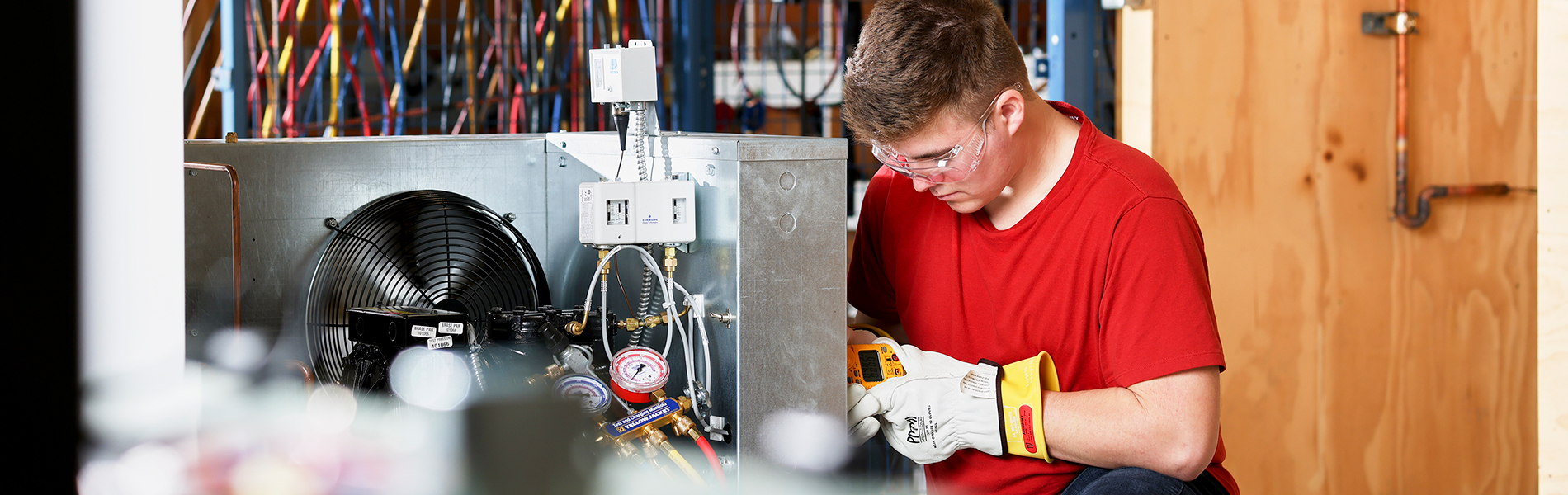
The Heating, Ventilation and Air Conditioning Technology (HVAC) program gives you a broad base of training that can lead to two Red Seal trades.
You will learn how to install and service HVAC and refrigeration systems for residential and commercial applications. You will train on everything from heat pumps, oil and gas heat, and ventilation equipment to commercial refrigeration walk-in coolers and freezers, rooftop air conditioning units and more. On-the-job training will give you even more experience and expose you to various trades and professions within the field.
This program is located at our Summerside Waterfront Campus. Take a virtual tour.
This site is protected by reCAPTCHA and the Google Privacy Policy and Terms of Service apply.
Thank you for reaching out!
Your information has been submitted successfully. A member of our team will be in touch with you soon.
September 2027
Summerside Waterfront Campus
Program Length
2 Years
Credential
Diploma, Heating Ventilation and Air Conditioning Technology
Canadian Tuition
International Tuition
Canadian Applicants
Accepting Applications
International Applicants with a Valid Study Permit
Accepting Applications
Other International Applicants
Accepting Applications
Don’t have the courses you need to get into this program? Visit our Academic Upgrading section to learn how to upgrade high school credits or get your high school equivalency credential (CAEC).
This program has degree pathways, giving you the opportunity to receive credit for your Holland College diploma when you continue your education. For a complete list of agreements, visit the Degree Pathways page.
| Partner Institution | Credential | Details of Agreement |
|---|---|---|
| University of New Brunswick - Saint John | Bachelor of Applied Management | Graduates with a 70% average receive two years of credit toward a Bachelor of Applied Management degree. |
SAFE-1005
An overview of the Occupational Health and Safety Act...
0
BLPR-1115
This course introduces students to the basics of drafting. In addition, students become familiar with the reading of blueprints for residential construction.
2.00
COMM-1005
This course is designed to allow students to develop preparatory skills for securing and retaining employment including; workplace communication, time management, critical thinking and problem-solving, and customer service. Upon successful completion of this course students are able to use oral communications techniques, and create a variety of written documents and reports used in the workplace. Methods and strategies for job search, preparation and retention are also incorporated.
3.00
COMP-1000
Students learn productivity software and explore digital environments with practical applications for various workplaces and educational institutions. The main areas of focus include word processing, spreadsheets, presentation software, email and other electronic communication tools, various digital environments, and industry-specific applications.
3.00
HVAC-1001
This course is designed to introduce students to occupational health and safety hazards and best practices in the Heating, Ventilation, and Air Conditioning trade. Students learn about provincial legislation, best practices pertaining to safely using tools and equipment, and how to recognize safety hazards that are common to job sites. Students are introduced to various tools, fasteners, piping practices and equipment used in industry today and gain practical experience in their use.
3.00
HVAC-1100
Upon completion of this course students are able to identify various types of oil burners and burner components. In addition, students learn to install, service and troubleshoot oil-fired heating systems.
3.00
HVAC-1110
Upon completion of this course, students are able to identify gas burners and burner components. In addition, students become familiar with servicing and troubleshooting gas fired heating systems.
3.00
HVAC-1155
This course is a basic electrical course that includes safety concerns when dealing with electricity. The types of electrical injuries are explained, along with preventative measures technicians should use. Students are introduced to basic electrical principles, the characteristics of electrical circuits and electrical meters and their uses. This course lays a foundation for reading and interpreting system wiring diagrams and provides students with an understanding of direct current, alternating current, power distribution and voltage systems.
3.00
HVAC-1161
This course is designed to introduce students to various refrigerants used in industry along with the safe handling of those refrigerants. Students perform the proper procedures for refrigerant recovery, recycling, and reclaiming as well as procedures for system evacuation, dehydration, charging and retrofitting.
5.00
HVAC-1171
This course introduces students to the theory of heat, energy and matter, the thermal properties of various substances, the building envelope, and the heat exchange process. Students also explore the components and operation of solar heating systems, as well as basic refrigeration systems.
3.00
HVAC-1185
Students learn methods and practices commonly used to install residential heating and cooling equipment. Students gain experience using common construction tools and fasteners, and learn to use technical documentation to plan for and perform an installation of a system.
1.00
HVAC-2010
Upon completion of this course the students have an understanding of the basic concepts of hydronic heating systems, along with system service, installation, and troubleshooting.
3.00
HVAC-2020
This course is designed to introduce the student to duct material, air distribution systems, indoor air quality, the properties of air and system balance.
3.00
HVAC-2025
This course covers the installation and troubleshooting of the following electrical systems: heating, cooling, and refrigeration, line and low-voltage and control systems. Students learn to identify and select line voltage and control conductors, select thermostats, pressure switches, and other electric control devices. Students troubleshoot electric control devices and circuitry for air-conditioning, modern refrigeration, and heating systems, and are introduced to remote access management tools.
4.00
HVAC-2050
This course is designed to introduce students to basic electric motors used in the HVAC/R industry. This course also looks at components for electric motors and the contactors, relays, and overloads used for motor starting and protection.
3.00
HVAC-2060
This course familiarizes students with refrigerant piping practices to enable them to install refrigerant piping and identify faults in existing refrigerant piping designs. Students learn about pipe requirements and sizing, insulation and hanging requirements, along with causes of and solutions to system vibration and noise.
3.00
HVAC-2075
This course is designed to introduce students to electric heating equipment, as well as Air-to-Air and Geothermal Heat Pump systems. Students learn the procedures for installing, servicing, and troubleshooting these systems.
4.00
HVAC-2085
Learn about refrigeration systems including how to identify and install the various system components, including evaporators, condensers, metering devices, compressors and system accessories. Explore typical operating conditions for high, medium, and low temperature refrigeration systems, and troubleshoot abnormal conditions.
5.00
HVAC-2090
Students are introduced to typical air conditioning systems, and learn how to identify and select systems according to their application. Students learn to analyze the psychometric chart, perform heat load calculations, and determine comfort conditions. In addition, students learn to install systems, including performing start-up, testing, and adjusting of equipment as required.
4.00
MATH-1005
This course is designed to provide students with a review of fundamental trade related math skills. Students acquire competency in the math skills as they relate to their chosen trade program and future career. Emphasis is placed on developing problem solving and critical thinking skills. Students are challenged to continually make connections between math and their trade, as well as every day applications.
2.00
MATH-1210
An applied math course for students to develop the skills to explain concepts of heat, temperature, freezing, and boiling. Students investigate impacts of temperature change, heat transfer methods and calculate heat transfer. Students learn to apply trigonometry to solve problems involving angles and use Ohm's law to solve problems with electric circuits. In addition, students calculate force, work, energy and power, examine gears, pulleys and torque, and examine solids, liquids and gases.
3.00
NCPR-1001
A comprehensive two-day course offering standard first aid and cardiopulmonary resuscitation (CPR) skills from a certified trainer. As required by regulation, this course covers CPR and the management of other breathing, airway and circulation emergencies, as well as, the control of bleeding, treating shock, stabilizing fractures and dislocations, head and spine injuries, and more. Also, includes automated external defibrilators (AED). This certification expires in 3 years.
0.00
NCPR-1002
Students complete Workplace Hazardous Materials Information System (WHMIS) training and certification.
0.00
NCPR-1066
Students are trained and become certified in the application and use of fall protection equipment. Students explore hazards, legislative requirements, as well as various types of fall protection systems and their components. Demonstration of the proper application and use of fall protection is required in order to pass this course.
0.00
NCPR-1068
Students acquire knowledge, demonstrate proficiency, and become certified in the safe use of elevated work platforms. Please note that Certified Fall Protection training is a pre-requisite for this course, and students are expected to supply their own personal protective equipment, including hard hat, eye protection, and steel toed footwear.
0.00
NCPR-2010
This environmental awareness training program, based on Environment Canada's "Code of Practice for Elimination of Fluorocarbon Emissions in Refrigeration and Air Conditioning Systems", deals with environmentally-correct equipment design, proper handling of refrigerants, and prepares participants for complying with Federal and Provincial Regulations covering refrigeration and air conditioning systems. Specific topics covered are: Science of ozone depletion, leak detection methods, system charging procedures, special maintenance provisions, and refrigerant recovery, reuse, recycle and reclamation equipment.
0.00
PRAC-1500
On-the-job training provides students with an opportunity to apply acquired skills and knowledge to a relevant work environment. Participants are expected to assume the duties normally expected of an entry-level person in a similar position with appropriate supervision. The exposure to and interaction with the various trades and professions within the field provides students with an invaluable experience that enhances their overall learning.
3.00
PRAC-2500
On-the-job training provides students with an opportunity to apply acquired skills and knowledge to a relevant work environment. Participants are expected to assume the duties normally expected of an entry-level person in a similar position with appropriate supervision. The exposure to and interaction with the various trades and professions within the field provides students with an invaluable experience that enhances their overall learning.
4.00
Upon successful completion of the program, graduates will be able to:
The Heating, Ventilation and Air Conditioning Technology program is an excellent program to give you a broad base of training that can lead to two Red Seal trades. This program enables you to earn 30 hours of apprenticeship time per week of training and write the Apprenticeship block one exam for Oil Heat System Technician and the Apprenticeship block one exam for Refrigeration and Air Conditioning Mechanic, which puts you well on your way to Red Seal certifications. Upon graduation, once you are working with a suitable employer, you will register as an apprentice to complete your journey to challenge the Red Seal exam. When you register, Apprenticeship PEI will give you credit for the hours earned and block exams passed while you were at Holland College.
A Red Seal gives you the ability to work anywhere in Canada without further testing or certification.

The HVAC program at Holland College stands out for its practical hands-on training. Students benefit from industry-relevant skills and gain experience with real-world equipment. The program’s knowledgeable instructors foster a supportive learning environment, preparing graduates for successful careers in heating, ventilation, and air conditioning.
Graduating Student Survey Respondent, Class of 2024