Culinary Arts
The Culinary Institute of Canada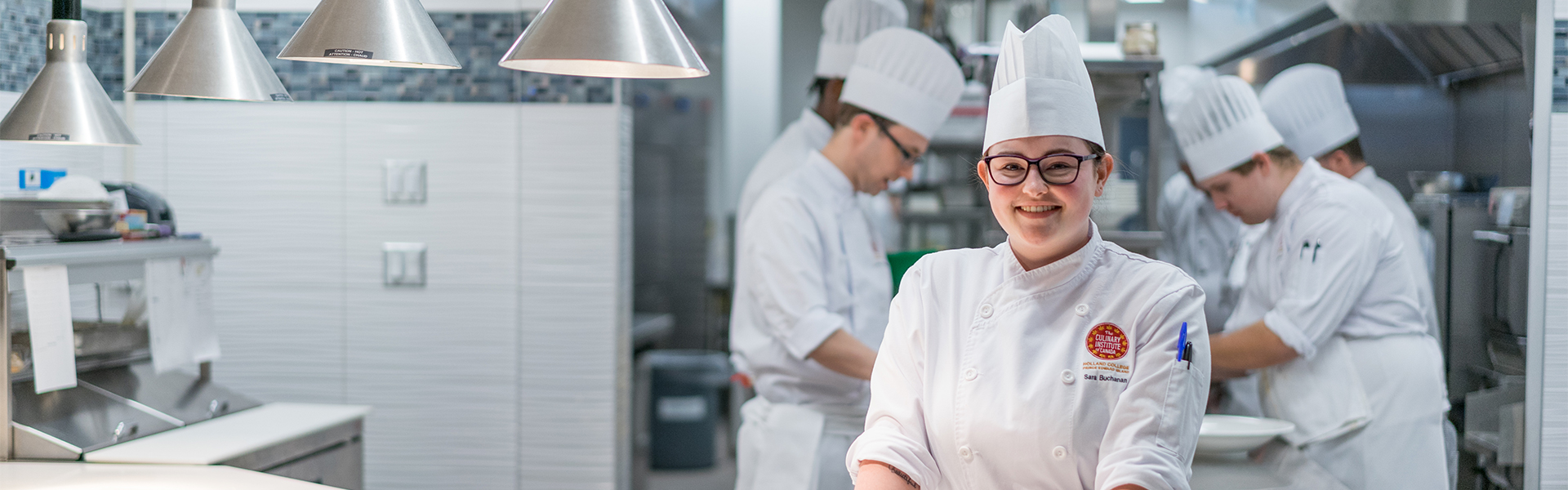
In the Culinary Arts program, you will gain a comprehensive understanding of culinary skills from the very basics of knife skills and food preparation to advanced techniques in butchery, international cuisine, and à la carte production.
The Culinary Institute of Canada is widely regarded as Canada's premier culinary school. You will sharpen your skills daily with rotations in our on-site restaurants for lunch service and fine dining. This high-volume food preparation gets you ready for a career in the fast-paced food service industry. Your culinary skills will be complemented by business training to prepare you for the full scope of restaurant operations.
This site is protected by reCAPTCHA and the Google Privacy Policy and Terms of Service apply.
Thank you for reaching out!
Your information has been submitted successfully. A member of our team will be in touch with you soon.
September 2027
Tourism & Culinary Centre
Program Length
2 Years
Credential
Diploma, Culinary Arts
Canadian Tuition
International Tuition
Canadian Applicants
Accepting Applications
International Applicants with a Valid Study Permit
Accepting Applications
Other International Applicants
Accepting Applications
Don’t have the courses you need to get into this program? Visit our Academic Upgrading section to learn how to upgrade high school credits or get your high school equivalency credential (CAEC).
This program has degree pathways, giving you the opportunity to receive credit for your Holland College diploma when you continue your education. For a complete list of agreements, visit the Degree Pathways page.
| Partner Institution | Credential | Details of Agreement |
|---|---|---|
| Royal Roads University | Bachelor of Arts in International Hotel Management | Graduates receive two years of credit toward the Bachelor of Arts in International Hotel Management degree. |
| Toronto Metropolitan University | Bachelor of Commerce in Hospitality and Tourism | Graduates receive up to two years of credit toward a Bachelor of Commerce in Hospitality and Tourism degree. |
| University of New Brunswick - Saint John, NB | Bachelor of Applied Management | Graduates with a 70% average are granted two years of credit toward a Bachelor of Applied Management degree. |
| University of Prince Edward Island | Bachelor of Business in Tourism & Hospitality | Graduates with a 70% average receive 60 credits toward a Bachelor of Business in Tourism & Hospitality degree. |
SAFE-1005
An overview of the Occupational Health and Safety Act...
0
BUSI-2550
Develop an understanding of culinary entrepreneurship and the resources needed to begin a new business in the food industry. Examine the legal forms of business and anaylyze the legislation applicable to ownership. Learn the daily operations of food and beverage service in the hospitality industry including elements of human resource management and supervision.
4.00
COMM-1005
This course is designed to allow students to develop preparatory skills for securing and retaining employment including; workplace communication, time management, critical thinking and problem-solving, and customer service. Upon successful completion of this course students are able to use oral communications techniques, and create a variety of written documents and reports used in the workplace. Methods and strategies for job search, preparation and retention are also incorporated.
3.00
COMP-1000
Students learn productivity software and explore digital environments with practical applications for various workplaces and educational institutions. The main areas of focus include word processing, spreadsheets, presentation software, email and other electronic communication tools, various digital environments, and industry-specific applications.
3.00
CUIS-1250
Learn the fundamental skills needed to produce various baked goods and dessert items. Apply fundamental baking techniques and methods to produce products in an industry-like environment. Develop professional behaviours and attitudes to culinary industry standards.
4.00
CUIS-1450
Gain insight into the basic responsibilities of a cold cuisine/deli station. Experience the production flow of various hot and cold cuisine items, including pastas and pulses, from raw ingredients to final product presented to the customer. Develop professional behaviours and attitudes to culinary standards.
4.00
CUIS-1550
Learn the foundations of soup and sauce cookery. Gain insight into the making of derivative sauces and soups and exposure to contemporary sauce and soup making. Produce a variety of stocks, soups and sauces in an industry-like environment. Develop professional behaviours and attitudes to culinary standards.
4.00
CUIS-1750
Learn and apply the knowledge of meat, poultry, fish and shellfish identification and fabrication. Perform the break down of primal, sub-primal, and partial carcasses and apply processing techniques to various fish and shellfish. Practice the proper storing and handling techniques for meat, poultry, fish and shellfish. Develop professional behaviours and attitudes to culinary standards.
4.00
CUIS-1900
Learn to apply various cooking methods to proteins, vegetables and farinaceous products for both quantity cooking and to order (a la minute). Experience the production flow of food from its raw form to final product delivered to the customer. Develop professional behaviours and attitudes to culinary standards.
4.00
CUIS-2570
Learn advanced butchery and charcuterie skills as well as related purchasing and ordering specifications and cooking techniques specific to cold cuisine applications. Gain experience portioning and using preparation techniques for meat, game, poultry and seafood for food service. Learn the art of making a variety of classical and modern charcuterie items and explore the preserving techniques such as canning, smoking and curing. Gain hands on experience in the cheese making process. Explore Culinary Trends in food product development. Develop professional behaviours and attitudes to culinary standards.
6.00
CUIS-2580
Discover how the chef profession has evolved. Examine the evolution of cooking from pre-historic times to today. Learn how to create traditional and regional menus while integrating traditional terminology and techniques into the modern kitchen. Discuss the cuisine of Indigenous Peoples, as well as that of specific regions of Canada and the United States. Explore International cuisine and trends in modern restaurant landscapes, including intergrating International flavours, foodstuffs and techniques into a la carte menus. Discuss and discover products, history and heritage of the various regions and how they impact modern cuisine. Identify renowned chefs, their philosophies, and their commitment to using local ingredients.Develop professional behaviours and attitudes to culinary standards.
6.00
CUIS-2590
Using a variety of ingredients and techniques to produce for food service distribution, such as food trucks, grab-and-go, ghost kitchens, etc. Learn about menu development to the execution of various applications, including outlets, events, and culinary competitions. Explore food ingredients from around the world and incorporate in the creation of grab and go menu items. Develop practical skills such as organization, preparation, and service. Develop professional behaviors and attitudes to culinary standards.
6.00
CUIS-2595
In this practice-based course, students will learn and apply theory to an à la carte setting. Students will gain experience managing the required elements of rotisseur, garde manger, hot appetizers, entremetier, and saucier utilized for à la carte service. Develop professional behaviours and attitudes to culinary standards.
6.00
HOSP-1007
While gaining an understanding of viticulture and viniculture, discover types of wine (both domestic and international), and how they are produced. Learn the basics of wine tasting and explore food and wine pairing analysis. Explore the creation of beer, spirits and infusions along with mixology techniques used in hospitality operations.
3.00
HOSP-2167
Develop an understanding of the importance of controlling food, beverage and labor costs in the successful operation of a food and beverage outlet. Utilize cost control procedures as they apply to food, beverage and labor including, pricing, purchasing, storing, issuing, production, sales and scheduling.
3.00
NCPR-1001
A comprehensive two-day course offering standard first aid and cardiopulmonary resuscitation (CPR) skills from a certified trainer. As required by regulation, this course covers CPR and the management of other breathing, airway and circulation emergencies, as well as, the control of bleeding, treating shock, stabilizing fractures and dislocations, head and spine injuries, and more. Also, includes automated external defibrilators (AED). This certification expires in 3 years.
0.00
NCPR-1002
Students complete Workplace Hazardous Materials Information System (WHMIS) training and certification.
0.00
NCPR-1011
Prepare for mathematic calculations required for culinary professionals by reviewing mathematical operations, fractions, ratios and percentages.
0.00
NCPR-1012
Students will receive an orientation to the many types of knives, their purpose and the safety measures utlized in a culinary operation.
0.00
NCPR-1013
The internship is integral to the Culinary Arts program at The Culinary Institute of Canada. This experience allows the student to build on the skills developed in their first year of training. Our industry partners have indicated a need for a skill-based workforce, and this internship focuses on integrating a student's educational development into a real-world work environment. The student will also be able to integrate themselves into a culinary team environment and see firsthand what the culinary world has to offer and how they will fit into their chosen career. The student will identify and select a work site between their first year and second year of training and complete the required work hours during this work term. Each student will complete a personal portfolio of their experience to document and better illustrate to themselves the experiences they have had during the internship period.
0.00
NCPR-1050
Food Safety Certification is highly valued by service and hospitality industry employers seeking staff who are well-trained in the areas of safe food and materials handling procedures.
0.00
NUTR-1950
Explore the basic language of nutrition and the key concepts of healthy eating. Gain the foundational knowledge needed to communicate effectively with guests and to discuss dietary concerns. Learn about the basic nutrients, principles of healthy eating, food labelling, food allergies, and some common special diets. Explore the relationship between nutrition concepts and actual food by selecting, incorporating, and substituting wholesome, nutritious ingredients in meal planning and recipe design.
2.00
NUTR-2550
Build on the key concepts of nutrition and wellness as they relate to healthier meal choices for customers, culinary practices in the kitchen and the food industry in general. Learn to create nutritionally balanced meals from quality ingredients without compromising flavors. Focus will be on the selection of ingredients, modification of recipes and menu development to suit the needs of individual clients and improve the health profile of dishes served. Develop the ability to adjust cooking strategies and employ nutritionally sound cooking techniques in order to ensure currency with today's health conscious consumer and culinary trends.
2.00
Upon successful completion of the Culinary Arts program, graduates will be able to:
The Red Seal is the interprovincial standard of excellence for your chosen trade. When you have a Red Seal, you can work anywhere in Canada without further testing or certification. It gives you a competitive edge and flexibility in the market.
The Culinary Arts program is an excellent way to work on your Red Seal as a cook. In the program, you’ll earn 1,710 hours and write two block exams—putting you well on your way to certification.
After you graduate and are working with a suitable employer, you can register as an apprentice and get credit for the hours earned and block exams passed while you were at Holland College. Then you can complete the journey and take the Red Seal exam.

I appreciate that our culinary program allows us students to have hands-on in the kitchen as well as the experience of working with customers daily.
Graduating Student Survey Respondent, Class of 2024