Automotive Technology
Industrial Technology and Trades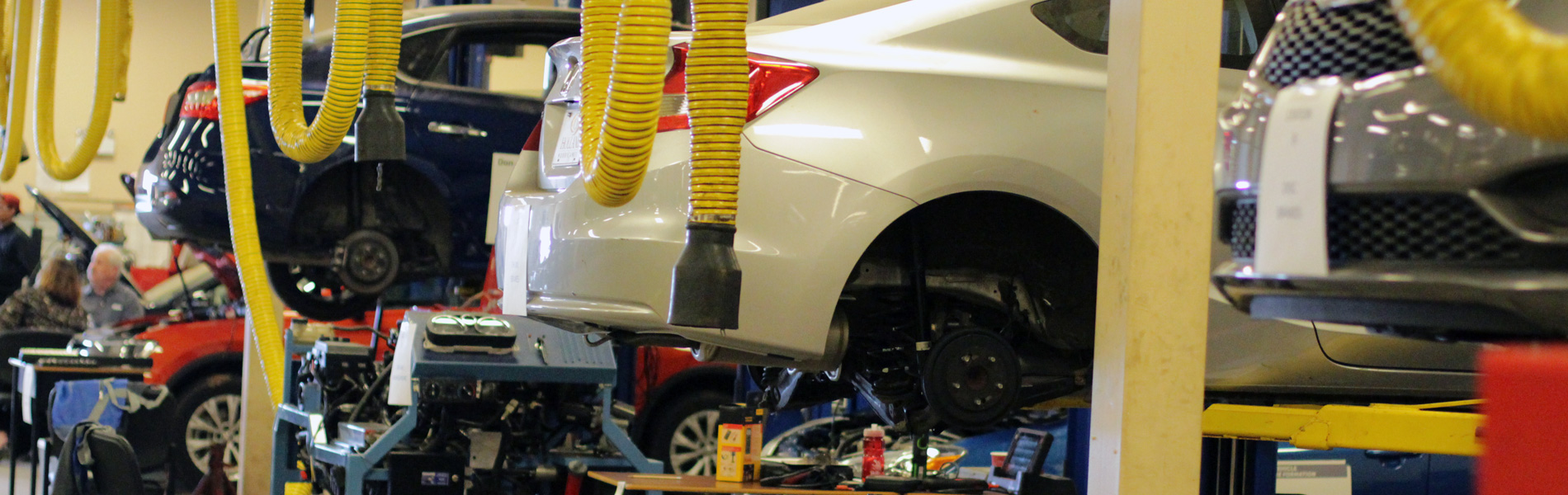
The Automotive Technology program provides a comprehensive introduction to the mechanical and technological skills you’ll need to work as an automotive service technician.
The program gives you a solid grounding in mechanical systems, computers, networks, electronics, and non-mechanical systems you’ll encounter on the job. You will take what you learn in the classroom and apply it in Holland College’s on-campus Automotive Technology shop, and on-the-job training will give you the opportunity to apply your skills in the workplace.
This program is located at our Summerside Waterfront Campus. Take a virtual tour.
This site is protected by reCAPTCHA and the Google Privacy Policy and Terms of Service apply.
Thank you for reaching out!
Your information has been submitted successfully. A member of our team will be in touch with you soon.
September 2027
Summerside Waterfront Campus
Program Length
2 Years
Credential
Diploma, Automotive Technology
Canadian Tuition
International Tuition
Canadian Applicants
Accepting Applications
International Applicants with a Valid Study Permit
Accepting Applications
Other International Applicants
Accepting Applications
Don’t have the courses you need to get into this program? Visit our academic upgrading section to learn how to upgrade high school credits or get your high school equivalency credential (CAEC).
This program has degree pathways, giving you the opportunity to receive credit for your Holland College diploma when you continue your education. For a complete list of agreements, visit the Degree Pathways page.
| Partner Institution | Credential | Details of Agreement |
|---|---|---|
| University of New Brunswick - Saint John | Bachelor of Applied Management | Graduates with a 70% average are granted two years of credit toward a Bachelor of Applied Management degree. |
SAFE-1005
An overview of the Occupational Health and Safety Act...
0
AUTO-1000
An introduction to the tools and equipment used by an Automotive Service Technician. Safe and efficient work habits, selection and maintenance of tools and equipment are practiced.
2.00
AUTO-1005
A thorough introduction to customer service, work orders, and professional demeanor as an Automotive Service Technician. Students explore and practice these skills while performing Motor Vehicle Inspections (MVI). Pre-Delivery Inspections (PDI) and preventative maintenance tasks. Students are also introduced to issues relating to body components and trim.
3.00
AUTO-1100
This course prepares students to diagnose and repair mechanical braking systems including disc, drum, and hydraulic brakes. Student use measuring tools and procedures to ensure that components meet safety requirements and apply safety best practices while servicing brake components and systems.
3.00
AUTO-1115
In this course students learn to analyze and service front and rear suspension systems, as well as inspect and repair tires, wheels, and wheel bearings. Students also learn to inspect and repair manual and power steering gears and steering columns, as well as how to perform two- and four-wheel alignments.
5.00
AUTO-1210
In this course students learn the fundamentals of electricity in relation to automotive vehicles. In addition, students are introduced to basic scan tools used for diagnosing issues with automotive computer systems.
3.00
AUTO-1221
Course Description: In this course students learn to diagnose, service and repair drivelines and axles. The training environment includes lectures, self-study and practical exercises.
2.00
AUTO-1225
This course is designed to provide students with an overview of the various types of engine assemblies, their components, as well as how they operate. Students learn to apply formulas used to calculate engine displacement, compression ratios, and horsepower.
2.00
AUTO-2100
This course is designed to further build on the skills taught in the Basic Electrical course, to teach students how Voltage, Amperage and Resistance can affect many electrical circuits. This course will also cover how to apply an automotive wiring diagram to the diagnostic approach to solve electrical faults. In addition, students learn how to properly set up and use advanced electrical diagnostic tools, such as Oscilloscopes.
3.00
AUTO-2110
In this course students learn about vehicle convenience systems. Topics include; body control modules, lighting, entertainment systems, anti-theft systems, as well as other instruments and safety devices found in automobiles. Students are shown how to diagnose and repair vehicle convenience systems.
3.00
AUTO-2115
Students learn about the function of vehicle electronic and computer systems, as well as how to diagnose, repair, and test these systems.
3.00
AUTO-2120
This course prepares students to work with ignition systems. Students learn about the function of manual and electric ignition systems, and how to conduct tests to diagnose problems, and service these systems based on their findings.
2.00
AUTO-2130
This course prepares students to service and repair different types of fuel delivery systems. Students learn about engine drivablility and performance and use scan tools and DVOM's to verify engine sensor data, and repair performance issues.
5.00
AUTO-2135
This course explores the various safety systems found in today's vehicles. Students learn to service and repair Electronic Brake Control (EBC) systems, as well as how to diagnose and repair occupant restraint systems. Students also investige different types vehicle driver assistance control systems designed to increase safety.
2.00
AUTO-2150
In this course students learn about automotive heating and cooling systems, and how to diagnose and repair those systems. Students are also required to complete the requirements for Ozone Depletion Substance handling.
2.00
AUTO-2200
In this course students learn about aspects of the engine's electrical system inlcuding how to test electrical charging systems, as well as inspect and service generators and starting systems.
2.00
AUTO-2205
Students learn about the operating principles of differential assemblies as well as methods to diagnose and repair these systems according to manufacturer's specifications.
2.00
AUTO-2222
Students learn to diagnose and repair manual transmissions, as well as automatic, dual-clutch, and continuously variable transmission (CVT) systems, including their operation, maintenance, and service procedures. Students also learn the function and operation of transfer cases, along with the procedures used to diagnose, service, remove, and install them.
5.00
AUTO-2225
This course prepares students to service and repair engine cylinder heads and associated components such as valves, valve springs, and camshafts. This course also teaches students the importance of automotive cooling systems in relation to regulating an engines temperature.
4.00
AUTO-2230
This course prepares students to service and repair engine cylinder blocks and its associated components such as crankshafts, pistons, connecting rods and oil delivery system. In addition students will learn engine diagnostic approaches to diagnose engine failures. This course also reviews the basic working principles of a 4 cycle internal combustion engine.
4.00
COMM-1005
This course is designed to allow students to develop preparatory skills for securing and retaining employment including; workplace communication, time management, critical thinking and problem-solving, and customer service. Upon successful completion of this course students are able to use oral communications techniques, and create a variety of written documents and reports used in the workplace. Methods and strategies for job search, preparation and retention are also incorporated.
3.00
COMP-1000
Students learn productivity software and explore digital environments with practical applications for various workplaces and educational institutions. The main areas of focus include word processing, spreadsheets, presentation software, email and other electronic communication tools, various digital environments, and industry-specific applications.
3.00
MATH-1005
This course is designed to provide students with a review of fundamental trade related math skills. Students acquire competency in the math skills as they relate to their chosen trade program and future career. Emphasis is placed on developing problem solving and critical thinking skills. Students are challenged to continually make connections between math and their trade, as well as every day applications.
2.00
MATH-1115
This course is designed to help students develop the mathematical skills necessary for success in the Automotive Technology program and in their future careers. Emphasis is placed on building problem-solving abilities and critical thinking through practical, trade-related applications.
2.00
NCPR-1001
A comprehensive two-day course offering standard first aid and cardiopulmonary resuscitation (CPR) skills from a certified trainer. As required by regulation, this course covers CPR and the management of other breathing, airway and circulation emergencies, as well as, the control of bleeding, treating shock, stabilizing fractures and dislocations, head and spine injuries, and more. Also, includes automated external defibrilators (AED). This certification expires in 3 years.
0.00
NCPR-1002
Students complete Workplace Hazardous Materials Information System (WHMIS) training and certification.
0.00
NCPR-2010
This environmental awareness training program, based on Environment Canada's "Code of Practice for Elimination of Fluorocarbon Emissions in Refrigeration and Air Conditioning Systems", deals with environmentally-correct equipment design, proper handling of refrigerants, and prepares participants for complying with Federal and Provincial Regulations covering refrigeration and air conditioning systems. Specific topics covered are: Science of ozone depletion, leak detection methods, system charging procedures, special maintenance provisions, and refrigerant recovery, reuse, recycle and reclamation equipment.
0.00
PRAC-1150
Working in an automotive service shop, students gain industry experience and apply skills and knowledge gained during the preceding courses.
3.00
PRAC-1250
Students gain industry experience and apply skills and knowledge gained during the preceding courses.
3.00
PRAC-2250
Students gain industry experience and apply skills and knowledge gained during the preceding courses.
3.00
WELD-1200
An introduction to basic welding and cutting operations used in the automotive trade with a focus on oxyacetalyne cutting, welding and brazing and Gas Metal Arc Welding.
1.00
Upon successful completion of the program, graduates will be able to:
Car dealerships
Independent garages
National auto chains
Service centres
Fleet maintenance
Customer service
Self-employment
Canadian Armed Forces
The Automotive Technology program is recognized as qualifying for subsidized education by the Canadian Armed Forces for the Vehicle Technician occupation. Students are eligible to receive a salary (with benefits), and support to offset tuition and materials if enrolled through the Canadian Forces Non-Commissioned Member Subsidized Training and Education Plan (NCMSTEP). Qualifying graduates of the Automotive Technology program also receive Recognition of Prior Learning and Experience and may receive advanced standing as a Vehicle Technician in the Canadian Armed Forces. For more information, please visit a Canadian Armed Forces recruiting centre or visit their webpage.
You’ll work on a fleet of diverse vehicles to develop your skills, then you will have an on-the-job training work placement where you will be in a real work environment. On-the-job training not only gives you valuable real-life experience, it also helps you build a network of potential employers.
The Red Seal gives you the ability to work anywhere in Canada without further testing or certification. The Red Seal is recognized as the Interprovincial standard of excellence for your chosen trade and is the designation most employers will ask for.
The most successful path to a Red Seal as an Automotive Service Technician begins with Holland College’s Automotive Technology program. You earn 30 hours of apprenticeship time for each week of training hours and write two block exams, which puts you well on your way to Red Seal certification. Once you are working with a suitable employer, you can register as an apprentice, and Apprenticeship PEI will give you credit for the hours earned and block exams passed while you were in Holland College’s Automotive Technology program.

I like the thorough communications that come from the instructors. All my instructors know how to engage with students, and they go the extra mile to make sure you're doing well in class. [I] went in knowing absolutely nothing about cars, now I'm praised for knowing so much constantly at my workplace in the field.
Graduating Student Survey Respondent, Class of 2024
Aircraft turbine technicians inspect and troubleshoot issues with aircraft engines and mechanical systems, and modify, repair, and overhaul turbine engines.
Earn your diploma in Electromechanical Technology and learn to repair hydraulic/pneumatic systems, programmable logic controllers, microprocessors and more.
As a Precision Machinist, you could create something that could become an integral part of an airplane or car, a piece of surgical equipment, or a major industrial machine.